
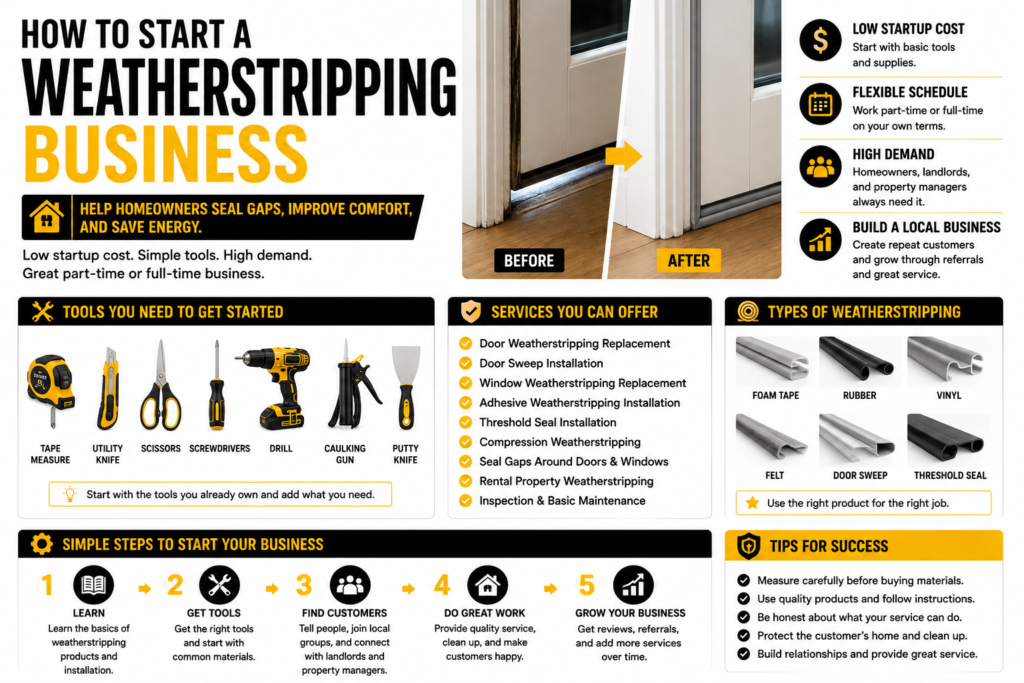
If you are good with your hands and enjoy fixing problems around homes, a weatherstripping business may be a simple way to turn your skills into income.
Doors and windows can develop gaps over time. Air can come in around the edges, making a home less comfortable and potentially increasing heating and cooling costs.
Replacing worn weatherstripping can be a relatively simple repair that many homeowners would rather pay someone else to handle.
That creates a business opportunity.
You can provide a service that helps homeowners, landlords, property managers, and businesses improve the fit around doors and windows.
A weatherstripping business can be started with basic tools and supplies. You may be able to work from home, travel to customers, and begin part-time.
This guide explains how to start a weatherstripping business, what services you can offer, what tools you need, how to find customers, how to set prices, and how to grow the business.
What Is a Weatherstripping Business?
A weatherstripping business installs or replaces materials designed to reduce gaps around doors and windows.
Depending on your skills and the products you use, your services may include:
- Replacing worn door weatherstripping
- Installing door sweeps
- Replacing window weatherstripping
- Sealing gaps around movable doors and windows
- Installing adhesive weatherstripping
- Installing compression weatherstripping
- Installing threshold seals
- Inspecting doors and windows for obvious gaps
- Replacing damaged sealing materials
- Weatherstripping rental properties
You do not need to offer every service when you start.
Begin with simple installations that you understand and can perform properly.
Why Start a Weatherstripping Business?
Weatherstripping is a small home repair that can make a noticeable difference.
Homeowners may notice cold air around a door in the winter or warm air entering around a door during the summer.
They may also notice light coming through a gap or feel air movement around the edges of a door.
Many people know there is a problem but do not know what product to buy or how to install it.
You can solve that problem for them.
You Can Start With Little Money
Weatherstripping does not require a large workshop.
Many jobs can be performed with basic hand tools.
You can purchase materials as customers request them rather than keeping a large inventory.
You Can Work From Home
You may not need a commercial building.
Depending on local rules, you may be able to operate from home and travel to customers.
You Can Start Part-Time
You can schedule jobs around another job, family responsibilities, or retirement.
Starting part-time also lets you test demand before making the business your full-time work.
You Can Add Other Services
Weatherstripping can be combined with other simple home repair services.
You may eventually offer caulking, screen repair, cabinet hardware installation, door hardware installation, or other services that match your skills and local requirements.
How Much Money Do You Need to Start?
Your startup cost depends on the tools you already own and the type of weatherstripping you plan to install.
Basic tools may include:
- Tape measure
- Utility knife
- Scissors
- Screwdrivers
- Drill
- Drill bits
- Hammer
- Pliers
- Putty knife
- Caulking tool
- Level
- Pencil
You may also need materials such as weatherstripping, door sweeps, thresholds, fasteners, and appropriate sealants.
You do not need to buy a large amount of inventory when you are starting.
Buy materials based on the jobs you have.
Start With the Tools You Already Own
If you have experience with home repairs, maintenance, construction, or remodeling, you may already own most of the basic tools.
Before spending money, check your toolbox.
Make a list of what you already have and then purchase only the tools you actually need.
Your goal is to start making money, not to build a perfect workshop.
Learn How Weatherstripping Works
Before charging customers, learn the purpose of the different products you plan to install.
Weatherstripping is used around movable parts of doors and windows to help close gaps when they are shut.
Different products are designed for different applications.
You may encounter:
- Adhesive foam weatherstripping
- Rubber weatherstripping
- Vinyl weatherstripping
- Felt weatherstripping
- Compression seals
- Door sweeps
- Threshold seals
Follow the manufacturer’s instructions for the specific product.
Measure Before You Buy
One of the easiest ways to lose money is to buy the wrong material.
Measure the door or window before purchasing weatherstripping.
You may need to determine:
- Length
- Width
- Gap size
- Door or window configuration
- Existing weatherstripping type
Do not assume that one product will work for every door and window.
Inspect the Existing Problem
Before replacing weatherstripping, look at the entire area.
The problem may not be caused by the weatherstripping alone.
A door may be out of alignment, a frame may be damaged, or another problem may be creating the gap.
If the underlying problem requires work outside your skill level, explain it to the customer.
Do not cover up a larger problem with new weatherstripping.
Door Weatherstripping
Doors are one of the easiest places to start.
Common door weatherstripping jobs include:
- Replacing worn seals
- Installing new door sweeps
- Replacing damaged bottom seals
- Replacing side seals
- Replacing top seals
Follow the product instructions and make sure the door still opens and closes properly after installation.
Door Sweeps
A door sweep is installed along the bottom of a door to help close the gap between the door and the floor or threshold.
A worn or damaged sweep may allow air, dust, insects, or light to enter underneath the door.
Door sweeps come in different styles and sizes.
Measure before purchasing a replacement.
Window Weatherstripping
Windows can also have worn or damaged sealing materials.
Older windows may need replacement weatherstripping or other maintenance.
Learn the correct product and installation method for the specific window before taking the job.
Some window repairs may require more specialized skills than simple weatherstripping.
Do Not Promise Huge Energy Savings
Weatherstripping can help reduce unwanted air movement, but you should be careful about making promises about energy savings.
The amount of improvement depends on the condition of the home, the doors and windows, insulation, HVAC system, weather, and many other factors.
Tell customers what your service is designed to do rather than promising a specific reduction in their utility bill.
How to Find Your First Customers
You do not need a large advertising budget to begin.
Start with people and businesses close to you.
Tell People You Know
Tell friends, relatives, neighbors, and former coworkers that you provide weatherstripping services.
Be specific about the problem you solve.
You could say:
“I replace worn weatherstripping and door sweeps to help close gaps around doors and windows.”
A simple explanation makes it easier for people to understand your service.
Use Local Community Groups
Local community groups can help you reach homeowners.
Keep your advertisement simple.
Tell people:
- What you repair
- What area you serve
- Whether you offer inspections
- Whether you provide materials
- How customers can contact you
Use Before-and-After Photos
Weatherstripping is a visual service.
Photographs can show customers what worn seals look like and what the finished repair looks like.
Take photographs of your own work and get permission before using a customer’s property in your advertising.
Work With Landlords
Landlords may have many doors and windows that need maintenance.
Weatherstripping may become worn over time, especially in older rental properties.
Contact local landlords and explain your service.
If you provide dependable work, a landlord may call you whenever another property needs weatherstripping.
Work With Property Managers
Property managers may oversee apartments, houses, offices, or other buildings.
They may need small maintenance jobs completed regularly.
A weatherstripping business can become one of the small maintenance services they call when a problem appears.
Work With Home Repair Businesses
Other contractors may find weatherstripping problems while working on homes.
Handymen, painters, remodelers, window companies, and property maintenance businesses may be able to refer customers to you.
Build relationships with businesses that serve the same customers.
Work With Realtors
Real estate agents may notice doors that do not seal properly when preparing a property for sale.
A small repair may improve the condition and appearance of the property.
Introduce yourself to local real estate professionals and explain what you do.
How Much Should You Charge?
Your price should cover more than the cost of the weatherstripping.
You are also providing:
- Labor
- Travel
- Tools
- Measurement
- Installation
- Cleanup
- Customer service
- Business expenses
Charge for the Complete Job
For simple jobs, a flat-rate price can be easy for customers to understand.
Your price can include the material and installation.
Charge for Larger Jobs by Time
For larger or uncertain jobs, you may prefer to charge based on labor time plus materials.
Explain your pricing before beginning the work.
Set a Minimum Service Charge
A minimum charge can help cover the cost of traveling to a customer’s property.
Even a small job requires travel, setup, installation, cleanup, and administration.
Do Not Underprice Your Work
A common mistake is charging too little because weatherstripping appears to be a simple repair.
The customer is paying for your ability to identify the problem, choose the correct material, measure it, install it properly, and complete the job.
They are also paying for your tools, vehicle, time, and business expenses.
Simple does not mean worthless.
Keep Your Service Area Reasonable
When you are starting, stay relatively close to home.
Driving a long distance for a small repair can quickly reduce your profit.
A smaller service area can help you spend more time working and less time driving.
You can expand later if the numbers make sense.
Protect the Customer’s Home
Customers are trusting you to work inside their homes.
Protect floors, doors, windows, furniture, and other surfaces while you work.
Be careful when using knives, drills, adhesives, and other tools.
Clean the work area when you finish.
Clean Up After Every Job
Small home repairs can create scraps, packaging, adhesive residue, and other waste.
Do not leave the customer with a mess.
Clean the work area and remove waste appropriately.
A clean job can make a strong impression.
Can You Start Part-Time?
Yes.
Weatherstripping can work well as a part-time service.
You can schedule jobs during evenings, weekends, or other times that work for you.
Starting part-time can allow you to learn the business without immediately depending on it for all of your income.
What If You Are Retired?
If you are retired and enjoy working with your hands, this type of business can give you a way to stay active and earn additional income.
You can decide how many jobs you want to accept.
You do not have to build a large company.
A small number of profitable jobs each week may be enough to make the business worthwhile for you.
What If You Do Not Like Resumes and Job Interviews?
Some people would rather solve problems with their hands than spend their time applying for traditional jobs.
A service business can provide another possible way to earn money from a useful skill.
A homeowner has a door with a large gap.
You know how to measure it and install the right weatherstripping.
You provide the service and get paid for solving the problem.
You are building a business around a skill instead of waiting for an employer to hire you.
What If You Have a Criminal Record?
A criminal record can make traditional employment more difficult for some people.
Self-employment can provide another possible path for someone who has useful skills and wants to work.
Customers may care about whether you show up, communicate honestly, do good work, and take care of their property.
You still need to follow applicable laws, licensing requirements, insurance requirements, and local business rules.
Keep Good Records
Even a small business should keep basic records.
For each job, record:
- Customer name
- Contact information
- Job address
- Door or window type
- Weatherstripping used
- Measurements
- Materials purchased
- Labor time
- Price quoted
- Payment received
Also keep records of your business expenses and follow applicable tax requirements.
Common Mistakes to Avoid
Buying Too Much Inventory
Do not spend a lot of money buying every type and size of weatherstripping.
Start with common products and purchase special materials when customers need them.
Using the Wrong Product
Different doors and windows require different products.
Make sure the material is appropriate for the application.
Not Measuring
Measure before purchasing materials.
Guessing can result in wasted material and extra trips.
Ignoring the Real Problem
A large gap may be caused by a damaged door, frame, hinge, or window.
Do not simply cover a larger problem with weatherstripping.
Overpromising Energy Savings
Do not guarantee a specific reduction in heating or cooling costs.
Many factors affect a home’s energy use.
Rushing the Installation
Take your time.
Proper measurement and installation can make the finished repair look much better.
How to Grow a Weatherstripping Business
You can start with one simple service and gradually add more.
A possible growth path could look like this:
- Start with basic door weatherstripping.
- Add door sweeps.
- Add window weatherstripping.
- Build customer reviews.
- Work with landlords.
- Contact property managers.
- Build relationships with realtors.
- Add caulking services.
- Add other simple home repairs.
- Expand your service area when demand supports it.
You do not have to follow this exact plan.
Build the business around the services customers in your area actually need.
Is a Weatherstripping Business Right for You?
If you enjoy working with your hands and solving simple problems around homes, a weatherstripping business may be worth considering.
You can start small.
You can use tools you already own.
You can buy materials as needed.
You can work part-time.
You can build relationships with homeowners, landlords, property managers, and other local businesses.
Then you can add services as your customer base grows.
You do not need a large amount of money to start a business based on a useful skill.
Find a problem, solve it, help the customer, and build your business one job at a time.
Next Article
How to Start a Caulking Business
Previous Article
How to Start a Lock Replacement Business
Related Articles
If you are interested in starting a home repair or maintenance business, these related guides may also help: