
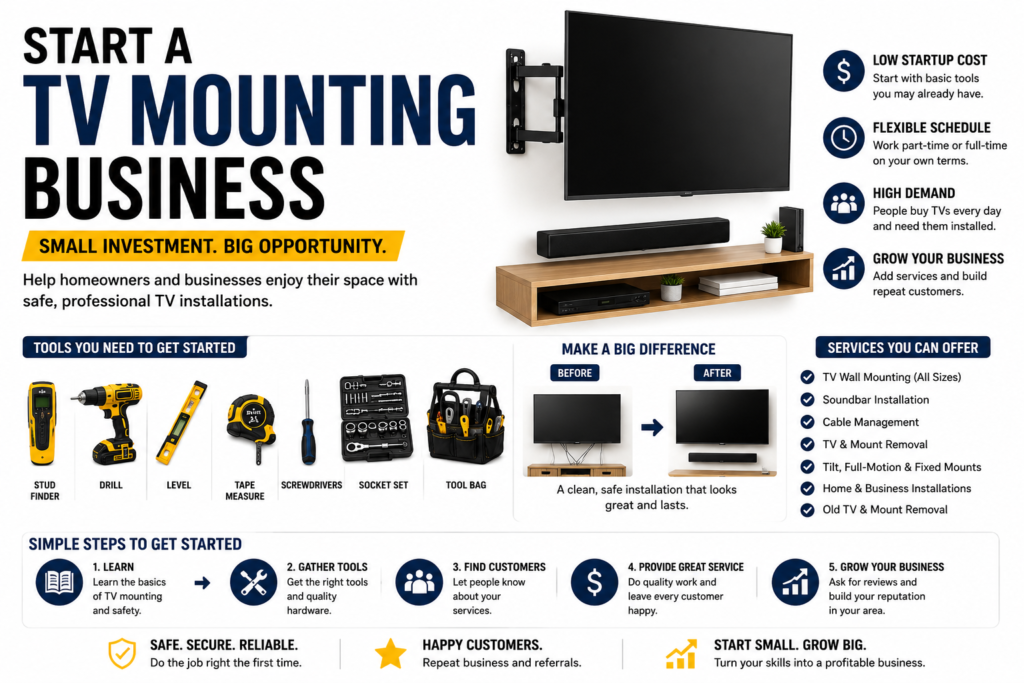
If you are good with tools and know how to install things around a home, you may be able to turn that skill into a TV mounting business.
Many people buy large televisions but do not want to mount them on the wall themselves. They may be worried about finding the studs, choosing the right wall mount, drilling into the wall, hiding cables, or damaging their expensive television.
That creates a simple business opportunity.
You can provide the tools and skills needed to mount the television safely and neatly.
A TV mounting business can be started with a relatively small investment. You may be able to work from home, travel to customers, and start part-time.
This guide explains how to start a TV mounting business, what tools you need, how to find customers, how to charge for your work, and how to grow the business over time.
What Is a TV Mounting Business?
A TV mounting business installs televisions on walls for homeowners, renters, businesses, and other customers.
Depending on your skills and the services you offer, your work may include:
- Wall-mounting televisions
- Installing TV brackets
- Finding wall studs
- Leveling the television
- Connecting cables
- Installing soundbars
- Installing basic cable management
- Removing old wall-mounted televisions
- Replacing existing TV mounts
- Installing televisions in businesses
You do not have to offer every service when you start.
Start with the work you understand and can perform safely.
Why Start a TV Mounting Business?
People buy televisions all the time.
Many customers want their TV mounted on the wall but do not have the tools, experience, or confidence to do it themselves.
A large television can be expensive and difficult to handle.
Customers may not want to risk dropping it or putting holes in the wrong part of the wall.
You are solving a simple problem: the customer has a TV they want mounted, and you know how to install it.
You Can Start Small
You do not necessarily need a storefront or commercial building.
Depending on local rules, you may be able to operate the business from home and travel to customers.
You Can Work With Basic Tools
Many of the tools used for TV mounting are basic hand and power tools.
If you already do home improvement work, you may own some of them.
You Can Start Part-Time
You can take appointments on evenings, weekends, or other times that work for you.
As the customer list grows, you can decide whether to work more hours.
You Can Add Related Services
TV mounting can also lead to other home installation services.
You may eventually offer soundbar installation, shelf installation, cable management, picture hanging, smart-home device installation, or other services that match your skills and local requirements.
How Much Money Do You Need to Start?
Your startup cost depends on the tools you already own.
Basic TV mounting tools may include:
- Drill
- Drill bits
- Stud finder
- Level
- Tape measure
- Pencil
- Screwdriver set
- Socket set
- Wrenches
- Utility knife
- Wall anchors appropriate for the application
- Small hand tools
You may also want a few moving blankets or protective coverings to protect the customer’s television and furniture.
You do not need to buy everything at once.
Start with the tools required for the jobs you plan to perform.
Start With the Tools You Already Have
Before spending money, check your existing toolbox.
You may already have a drill, level, tape measure, screwdrivers, sockets, and other useful equipment.
Make a list of what you own.
Then buy only the tools that are missing.
Keep your startup costs low until you know there is demand for your service.
Learn About Different Wall Types
Not every wall is the same.
You may encounter:
- Drywall
- Wood studs
- Concrete
- Brick
- Block
- Other wall materials
The mounting method and hardware must be appropriate for the wall and the television mount.
If you are not comfortable working with a particular wall type, do not accept the job until you understand the correct installation method.
Learn How to Find Wall Studs
Finding the correct mounting location is one of the most important parts of TV installation.
A stud finder can help identify framing behind drywall, but you should understand how to verify the mounting location before drilling.
The mounting hardware must be installed according to the mount manufacturer’s instructions and the structure of the wall.
A television should never be mounted based only on guesswork.
Choose the Right TV Mount
There are several types of television mounts.
Fixed TV Mount
A fixed mount keeps the television close to the wall.
It can provide a clean appearance and is often used when the viewing position does not need to change.
Tilt TV Mount
A tilting mount allows the television to tilt up or down.
This can be useful when the television is mounted higher than eye level.
Full-Motion Mount
A full-motion mount allows the television to move and swivel.
These mounts can be more complicated to install and may require careful attention to weight limits and wall structure.
Always follow the mount manufacturer’s instructions and weight limits.
Know the Weight of the Television
Before installing a TV mount, determine the television’s weight and mounting specifications.
The mount must be rated for the television.
Do not assume that a mount can support a television simply because it looks strong enough.
Check the manufacturer’s specifications.
Understand VESA Mounting Patterns
Many televisions use a standard mounting-hole pattern commonly referred to as VESA.
The television’s mounting pattern must be compatible with the mount.
Check the television specifications and the mount specifications before beginning the installation.
Protect the Customer’s Television
A television can be expensive and fragile.
Handle it carefully.
When appropriate, use two people to lift and position larger televisions.
Protect the screen and surrounding furniture while working.
Never take unnecessary risks with a customer’s equipment.
Cable Management Can Add Value
Customers often want more than just the television mounted on the wall.
They may also want the cables organized.
You may be able to offer basic cable management using appropriate products.
For example, you may install surface cable covers or other solutions designed for the application.
Do not perform electrical work that requires a license unless you have the appropriate license and authorization.
Do Not Put Electrical Cables Inside Walls Without Knowing the Rules
Running power cables inside a wall can involve electrical code requirements.
Do not simply hide a television power cord inside the wall.
Use appropriate products and follow applicable electrical codes.
If electrical work requires a licensed professional in your area, refer that portion of the job to a qualified electrician.
How to Find Your First Customers
You do not need a huge advertising budget.
Start with your local area.
Tell People You Know
Tell friends, family members, neighbors, former coworkers, and other people you know about your service.
Be specific.
You could say:
“I provide professional TV mounting and installation. I come to your home and mount televisions safely and neatly.”
People are more likely to remember a specific service than a general statement that you do handyman work.
Use Local Community Groups
Local community groups can help you reach people who live close to you.
Keep your advertisement simple.
Tell people:
- What size televisions you work with
- What type of mounting you provide
- What area you serve
- Whether you install soundbars
- Whether you offer cable management
- How customers can contact you
Use Before-and-After Photos
TV mounting is a visual service.
Good photographs can show customers what your work looks like.
Take photographs of your own work and get permission before using a customer’s home or equipment in your advertising.
Work With Electronics Stores
Local electronics stores may sell televisions but may not want to handle every installation themselves.
Introduce yourself to local businesses and explain what services you provide.
A store may be able to refer customers who need installation.
Work With Realtors
Real estate agents may have clients who want televisions installed after moving into a new home.
Building relationships with local realtors can create referral opportunities.
Work With Property Managers
Apartment communities, rental properties, furnished rentals, and other businesses may need television installation.
Contact local property managers and explain your services.
Repeat customers can be valuable to a small business.
Work With Interior Designers
Interior designers and home decorators may have customers who need televisions installed as part of a room project.
A professional-looking installation can be an important part of a finished room.
How Much Should You Charge?
Your price should cover more than the time you spend drilling holes.
You also have:
- Travel time
- Fuel
- Tools
- Insurance
- Business expenses
- Setup time
- Cleanup time
- Your knowledge and experience
Flat-Rate Pricing
Flat-rate pricing can be easy for customers to understand.
You could create different prices based on the type of installation.
For example, a basic fixed-mount installation may have one price, while a more complicated full-motion installation may cost more.
Additional Services
You can charge separately for additional services such as:
- Soundbar installation
- Extra cable management
- Removal of an old television
- Removal of an old mount
- Installation on certain wall types
- Additional televisions
Make sure the customer knows what is included in the price.
Do Not Underprice Your Work
A common mistake is to charge too little because the actual installation may only take an hour or two.
The customer is paying for more than the time spent drilling.
They are paying for your experience and for the convenience of having someone else do the work.
They are also paying for the tools and knowledge needed to avoid an expensive mistake.
Your skill has value.
Set a Minimum Service Charge
A minimum service charge can make sense for a mobile TV mounting business.
You still have to drive to the customer, carry your tools inside, prepare the work area, install the television, clean up, and drive away.
Your minimum charge should account for the total cost of providing the service.
Keep Your Service Area Reasonable
When you start, you do not need to drive long distances for every job.
Focus on customers close to you.
A smaller service area can reduce fuel costs and give you more time to complete installations.
You can expand your service area when the business grows.
What If the Customer Bought the Wrong Mount?
This can happen.
A customer may buy a mount that is not compatible with the television or wall.
Check the mount before beginning installation.
If it is not appropriate, explain the problem to the customer.
Do not install equipment that you know is unsuitable.
What If the Wall Is Not Suitable?
Some walls require different mounting methods.
If you discover that the wall cannot safely support the installation as planned, stop and explain the problem.
Do not take shortcuts simply to finish the job.
Your reputation is more valuable than one installation fee.
Protect Yourself From Damage Claims
Working inside someone’s home creates risks.
Use reasonable precautions.
Protect floors and furniture.
Handle televisions carefully.
Follow installation instructions.
Consider appropriate business insurance for your situation.
Local requirements can vary, so check what applies to your business.
Can You Start Part-Time?
Yes.
TV mounting can work well as a part-time service.
You can schedule installations on evenings or weekends.
You can also take only the number of jobs you can comfortably handle.
If demand grows, you can increase your schedule.
What If You Are Retired?
If you enjoy working with tools and want to earn additional income, TV mounting may be a flexible option.
You can decide how many appointments you want to accept.
You can also choose which types of installations you are comfortable performing.
What If You Do Not Like Resumes and Job Interviews?
Some people would rather work with their hands than spend their time applying for traditional jobs.
A service business gives you another possible way to earn money from a useful skill.
A customer has a television that needs to be mounted.
You know how to install it.
You provide the service and get paid.
You are solving a problem instead of applying for a job.
What If You Have a Criminal Record?
A criminal record can make traditional employment more difficult for some people.
Self-employment can provide another possible path for someone with useful skills who wants to work.
Customers may care about whether you show up, do good work, communicate honestly, and take care of their property.
You still need to follow all applicable laws, licensing requirements, insurance requirements, and local rules.
Keep Good Records
Even a small business should keep basic records.
For each job, record:
- Customer name
- Contact information
- Job address
- Television make and model
- Television size and weight
- Mount type
- Wall type
- Services requested
- Materials used
- Price quoted
- Payment received
Also keep records of business expenses and follow applicable tax requirements.
Common Mistakes to Avoid
Guessing Where the Studs Are
Do not guess.
Use appropriate methods to locate and verify the mounting structure.
Using the Wrong Hardware
Use hardware appropriate for the wall, mount, and television.
Follow the mount manufacturer’s instructions.
Ignoring the Weight Limit
Make sure the mount is rated for the television.
Trying to Lift a Large TV Alone
Large televisions can be awkward and heavy.
Use another person when appropriate.
Hiding Power Cords Inside the Wall
Do not put a standard television power cord inside the wall.
Use an appropriate in-wall power solution or refer the electrical work to a qualified professional when required.
Rushing the Installation
Take your time.
A television that is slightly crooked may be obvious to the customer every time they look at it.
How to Grow a TV Mounting Business
You can start with one simple service and expand from there.
A possible growth path could look like this:
- Start with basic TV mounting.
- Build customer reviews.
- Take before-and-after photographs.
- Add soundbar installation.
- Add basic cable management.
- Work with realtors and property managers.
- Build relationships with electronics stores.
- Offer multiple-TV installations.
- Add other home installation services.
- Consider hiring help when demand justifies it.
You do not have to follow this exact path.
Build the business around the services customers in your area actually need.
Is a TV Mounting Business Right for You?
If you are comfortable using tools, working inside homes, and following installation instructions, a TV mounting business may be worth considering.
You can start small.
You can use tools you already own.
You can work part-time.
You can serve customers close to home.
Then you can add services as the business grows.
You do not need a large investment to start solving small problems for customers.
You need a useful skill, basic tools, and people who need the work done.
Next Article How to Start a Lock Replacement Business
Previous Article How to Start a Drywall Repair Business
Related Articles
If you are interested in starting a home repair or installation business, these related guides may also help: