A janitorial business isn’t glamorous.
Most of the work happens after office hours, when employees have gone home and buildings are empty. It’s the kind of business many people never think about—until they walk into a clean office every morning.
That’s exactly what makes it such a great business opportunity.
Businesses, schools, medical offices, churches, warehouses, and retail stores all need reliable cleaning services. Unlike one-time cleaning jobs, many commercial clients sign ongoing service agreements, creating recurring monthly income.
If you’re looking for a practical business that can be started with $0–$5,000, a janitorial business deserves serious consideration.
What Is a Janitorial Business?
A janitorial business provides routine cleaning and maintenance for commercial properties.
Typical customers include:
- Office buildings
- Medical offices
- Retail stores
- Churches
- Banks
- Schools
- Apartment common areas
- Warehouses
- Industrial buildings
Most customers hire janitorial companies weekly, several times a week, or every day.
Why This Business Is Worth Considering
Commercial cleaning is different from residential cleaning.
Instead of constantly looking for new customers, your goal is to build long-term contracts.
Advantages include:
- Recurring monthly income
- Commercial clients
- Year-round demand
- Easy to scale
- Can begin alone
- Can eventually operate multiple crews
- No college degree required
Is This Business Right for You?
| If You… | This Business May Be Right for You |
|---|---|
| Want recurring income | ✅ Excellent |
| Don’t mind evening work | ✅ Yes |
| Like building systems | ✅ Great fit |
| Want to eventually manage employees | ✅ Excellent |
| Prefer working only during the day | ⚠️ Maybe not |
| Want immediate high income | ❌ It takes time |
Pros and Cons
Pros
- Stable monthly income
- Long-term customer relationships
- Easy to expand
- Predictable scheduling
- Strong referral opportunities
Cons
- Evening and overnight work
- Employee management as you grow
- Contract bidding
- Customer expectations remain high
A Day in the Life
If you’re working alone, your day might look like this:
Morning
- Answer emails
- Prepare estimates
- Meet prospective customers
- Purchase supplies
Evening
- Clean offices
- Empty trash
- Vacuum
- Mop floors
- Clean restrooms
- Lock up buildings
Many successful owners eventually stop doing the cleaning themselves and focus on managing crews.
StartBusinessHub.com Tip
Don’t think of yourself as a cleaner. Think of yourself as building a company that happens to provide cleaning services. That mindset changes how you price, market, and grow your business.
Can You Start Part-Time?
Yes.
In fact, this is one of the best businesses to start while working another job because many commercial clients want cleaning performed after business hours.
You can gradually replace your employment income as you build recurring contracts.
Your First 30 Days
Week 1: Learn the Industry
- Research local janitorial companies.
- Learn common commercial cleaning standards.
- Decide what type of buildings you’ll target.
Goal: Pick a niche instead of trying to clean every type of building.
Week 2: Build Your Business
- Register your business.
- Purchase essential equipment.
- Set up your Google Business Profile.
- Build a website.
Goal: Look professional before contacting customers.
Week 3: Find Prospects
- Visit local businesses.
- Introduce yourself to office managers.
- Contact property management companies.
- Network with commercial real estate professionals.
Goal: Schedule your first walkthrough.
Week 4: Win Your First Contract
- Submit estimates.
- Follow up.
- Ask for referrals.
- Continue prospecting every week.
Goal: Land one recurring commercial account.
StartBusinessHub.com Tip
One office cleaned every week is worth much more than constantly chasing one-time jobs.
How Much Does It Cost to Start?
Starting with $0–$500
Purchase only basic supplies and focus on small offices.
Starting with $500–$2,500
You can purchase:
- Commercial vacuum
- Mop systems
- Cleaning chemicals
- Microfiber cloths
- Safety equipment
- Insurance
- Marketing materials
Starting with $2,500–$5,000
You can invest in:
- Floor scrubbers
- Burnishers
- Scheduling software
- Better branding
- Commercial equipment
Equipment You’ll Need
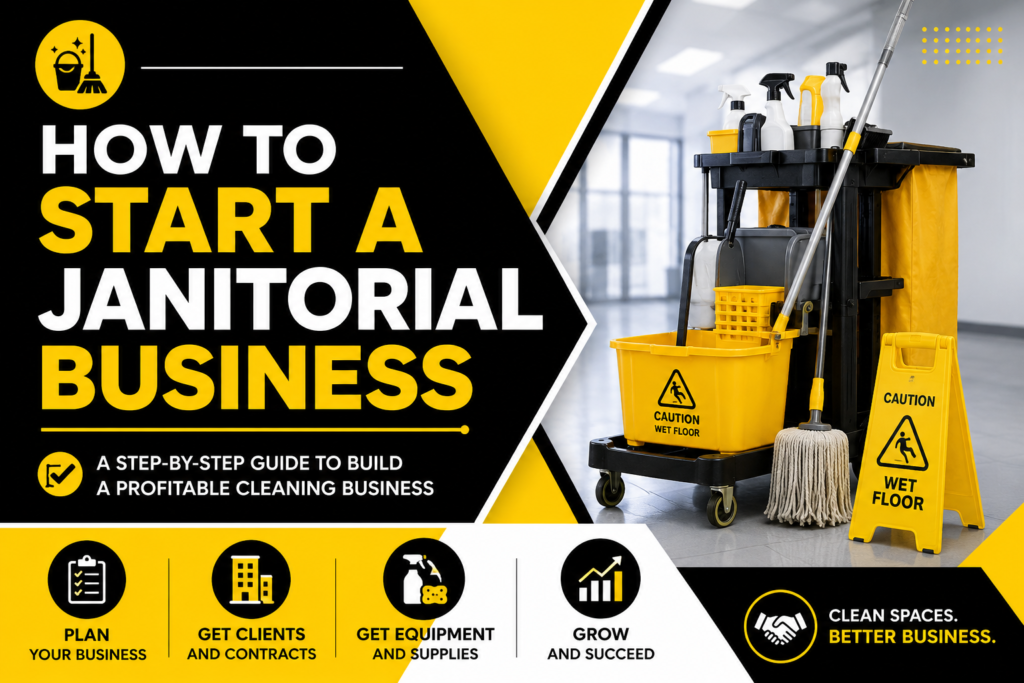
Basic equipment includes:
- Commercial vacuum
- Mop bucket
- Dust mop
- Wet mop
- Glass cleaner
- Restroom cleaner
- Degreaser
- Trash liners
- Gloves
- Wet floor signs
- Extension poles
- Microfiber towels
Licenses, Insurance & Legal Requirements
Research:
- Business registration
- General liability insurance
- Workers’ compensation (if hiring employees)
- Commercial auto insurance
- Local licensing
Many commercial customers require proof of insurance before signing a contract.
Services You Can Offer
- Office cleaning
- Restroom cleaning
- Trash removal
- Floor care
- Window cleaning
- Break room cleaning
- Supply restocking
- Post-construction cleanup
How Much Can You Really Make?
Your income depends on:
- Number of contracts
- Contract size
- Employee costs
- Equipment expenses
- Customer retention
Instead of trying to sign ten contracts immediately, focus on providing outstanding service to your first client. Strong referrals often become your most effective marketing.
Pricing Your Services
Commercial contracts are commonly priced by:
- Square footage
- Hours required
- Cleaning frequency
- Building type
- Scope of work
Never provide a quote without seeing the building whenever possible.
Finding Your First Customers
Focus on businesses rather than homeowners.
Good prospects include:
- Medical offices
- Law firms
- Banks
- Small office buildings
- Churches
- Retail stores
Marketing ideas:
- Google Business Profile
- Chamber of Commerce
- Property managers
- Networking events
- Referral programs
Marketing That Actually Works
Commercial clients care less about flashy advertising and more about professionalism.
Your marketing should communicate:
- Reliability
- Insurance
- Consistency
- Clear communication
- Attention to detail
Common Mistakes to Avoid
Underbidding Contracts
Winning an unprofitable contract can hurt your business.
Growing Too Fast
Build systems before hiring multiple employees.
Ignoring Customer Communication
Small problems become big ones if they’re ignored.
Buying Equipment Too Early
Don’t buy expensive floor machines until your contracts justify them.
When Should You Hire Your First Employee?
When:
- You’re consistently booked.
- Evening work exceeds your available hours.
- You’re turning away contracts.
- Administrative work consumes too much time.
Hire carefully.
Your employees represent your company every time they enter a customer’s building.
Growing Your Business
Expand into:
- Floor stripping and waxing
- Carpet cleaning
- Window cleaning
- Pressure washing
- Day porter services
- Medical office cleaning
- School cleaning
The goal isn’t simply to clean more buildings.
The goal is to build recurring revenue that allows your business to operate with trained crews while you focus on growth.
Is a Janitorial Business Worth It?
For entrepreneurs who value stability over excitement, a janitorial business is one of the best opportunities available.
It isn’t flashy.
It won’t make headlines.
But it can provide dependable monthly income, opportunities to hire employees, and a business that grows steadily over time.
That’s exactly the kind of business StartBusinessHub was built to help people discover.
Your First Goal
Don’t worry about cleaning the biggest office building in town.
Focus on:
- ✅ Winning your first contract.
- ✅ Showing up every time.
- ✅ Building trust.
- ✅ Asking for referrals.
- ✅ Reinvesting your profits.
One recurring contract can become the foundation of an entire business.
Frequently Asked Questions
Do I need commercial cleaning experience?
No. Many successful janitorial business owners started with no prior experience and learned through training, practice, and serving their first customers.
Can I start alone?
Yes. Many janitorial businesses begin with a single owner before hiring employees as contracts increase.
Do I need expensive equipment?
No. Start with the essentials and upgrade as your contracts grow.
Is this a good part-time business?
Yes. Because much of the work is performed after business hours, it’s one of the easiest businesses to start while keeping a full-time job.
Final Thoughts
A janitorial business is built on consistency. Customers aren’t looking for flashy marketing or complicated service packages—they want someone who shows up, does quality work, and keeps their building clean.
If you’re willing to provide reliable service, build long-term relationships, and grow patiently, this business can provide steady income for years to come.
Related Cleaning Business Guides
- How to Start a House Cleaning Business
- How to Start an Office Cleaning Business
- How to Start a Post-Construction Cleanup Business
- How to Start a Window Cleaning Business
- How to Start a Pressure Washing Business
- How to Start a Carpet Cleaning Business
- How to Start a Trash Bin Cleaning Business
- How to Start a Graffiti Removal Business
- How to Start an Air Duct Cleaning Business
- How to Start a Mattress Sanitizing Business
- How to Start a Tile & Grout Cleaning Business
- How to Start a Pool Cleaning Business
- How to Start a Janitorial Business
Or visit our Start a Cleaning Business hub to compare cleaning businesses that can be started with $0–$5,000 and find the one that best fits your budget, experience, and long-term goals.