
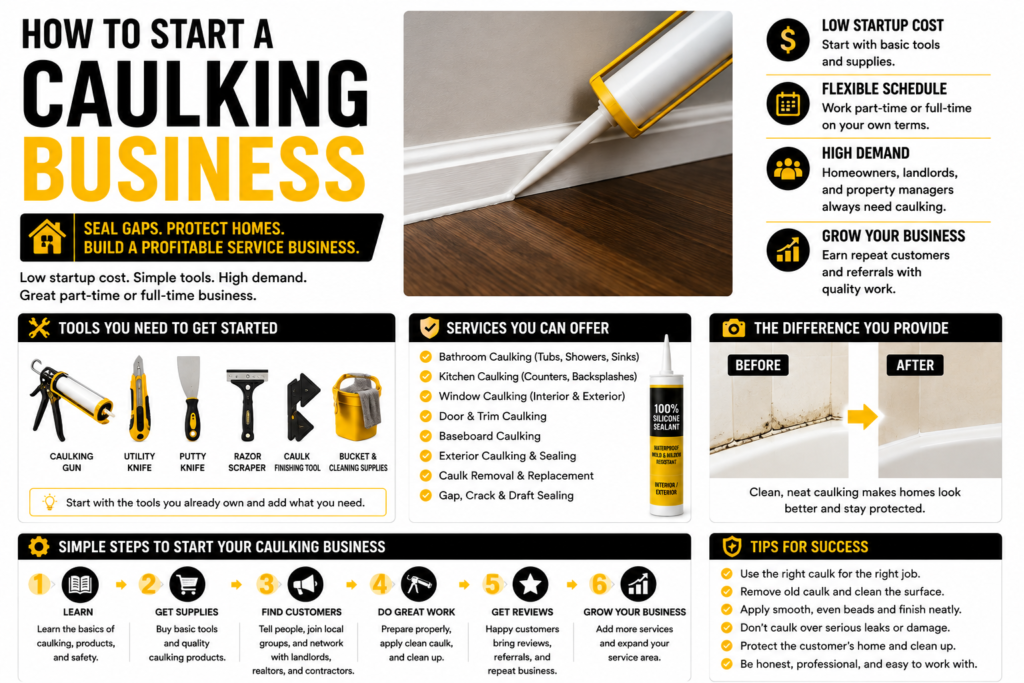
If you are good with your hands and enjoy fixing problems around homes, a caulking business may be a simple way to turn that skill into income.
Caulk is used in many places around a home. It can help seal gaps around windows, doors, tubs, sinks, countertops, backsplashes, trim, and other areas.
Over time, caulk can crack, shrink, peel, discolor, or separate from the surface.
Many homeowners do not want to spend their weekend removing old caulk and installing new caulk. They would rather pay someone who knows how to do the job neatly.
That creates a business opportunity.
A caulking business can be started with relatively little money. You may be able to work from home, travel to customers, and start with a small collection of tools and supplies.
This guide explains how to start a caulking business, what services you can offer, what tools you need, how to find customers, how to set prices, and how to grow the business.
What Is a Caulking Business?
A caulking business removes old or damaged caulk and applies new caulk or sealant where appropriate.
Depending on your skills and the type of work you are legally permitted to perform, services may include:
- Bathroom caulking
- Tub and shower caulking
- Sink and countertop caulking
- Kitchen backsplash caulking
- Window caulking
- Door and trim caulking
- Baseboard caulking
- Exterior caulking
- Draft and gap sealing
- Caulk removal and replacement
You do not need to offer every service when you start.
Start with jobs you understand and can complete properly.
Why Start a Caulking Business?
Caulking is one of those small home repairs that can make a noticeable difference.
Old caulk can make a bathroom look dirty even when the rest of the room is clean.
Cracked caulk around a tub or shower can also allow water to reach areas where it does not belong.
Gaps around windows and doors can allow unwanted air movement.
Customers may know that the caulk looks bad or is damaged, but they may not want to do the repair themselves.
You can solve that problem for them.
You Can Start With Basic Tools
You do not need a large workshop.
Many caulking jobs can be performed with inexpensive hand tools.
You Can Start Part-Time
You can take a few jobs each week and build the business slowly.
This can be useful if you already have another source of income or want to test the business before making it your full-time work.
You Can Work From Home
You may not need a storefront or commercial building.
Depending on local rules, you may be able to store your supplies at home and travel to customers.
You Can Add Related Services
Caulking can work well alongside other small home repair services.
You may eventually offer weatherstripping, drywall repair, screen repair, cabinet hardware installation, or other services that match your skills and local requirements.
How Much Money Do You Need to Start?
Caulking can have a relatively low startup cost because many of the basic tools are inexpensive.
Your starter tools may include:
- Caulking gun
- Utility knife
- Putty knife
- Scraper
- Razor scraper where appropriate
- Scissors
- Small brushes
- Caulk finishing tools
- Cleaning supplies
- Rags
- Bucket
- Drop cloths
- Gloves
You will also need different types of caulk or sealant depending on the jobs you accept.
You do not need to buy every type of product when you start.
Buy materials based on the work customers actually request.
Start With the Tools You Already Own
Before buying tools, look around your garage, basement, workshop, or toolbox.
You may already own a utility knife, scraper, screwdriver, caulking gun, bucket, rags, and other useful tools.
Make a list of what you have.
Then buy only what you need to complete your first jobs.
Your goal is to start earning money, not to build a giant inventory.
Learn How to Choose the Right Caulk
One of the most important skills in this business is knowing that different applications may require different products.
You may encounter products designed for:
- Bathrooms
- Kitchens
- Windows
- Doors
- Trim
- Exterior applications
- Paintable surfaces
- High-moisture areas
Read the manufacturer’s instructions and use the product only for applications for which it is designed.
Do not assume that one tube of caulk is suitable for every job.
Silicone vs. Acrylic Caulk
Different types of sealants have different properties.
For example, some silicone products are designed for wet areas, while certain acrylic or latex products may be easier to paint.
The correct choice depends on the surface, location, exposure to water, movement, and manufacturer’s instructions.
Learn the products you plan to use before charging customers.
Learn How to Remove Old Caulk
Good caulking often starts with good preparation.
Old caulk may need to be removed before new material is applied.
You may need to use a scraper, utility knife, or another appropriate tool.
Work carefully so you do not damage the surrounding surface.
Different materials require different techniques.
Clean the Surface Before Applying New Caulk
The surface needs to be properly prepared before new caulk is applied.
Old residue, dirt, grease, soap buildup, and moisture can interfere with the finished repair.
Follow the product manufacturer’s preparation instructions.
Allow surfaces to dry when required.
Do not rush the preparation.
Bathroom Caulking
Bathrooms can provide regular caulking work because they contain areas that are exposed to moisture.
Common jobs include:
- Bathtub edges
- Shower areas
- Sink areas
- Countertops
- Backsplashes
- Fixtures where appropriate
Use a product designed for the application and follow the manufacturer’s instructions.
Shower and Tub Caulking
Old caulk around a tub or shower can crack, discolor, or separate from the surface.
Replacing damaged caulk can improve the appearance of the bathroom and help maintain a proper seal where the product is intended to provide one.
However, caulk is not a substitute for repairing damaged plumbing, waterproofing, tile, or structural problems.
If you discover a larger problem, tell the customer.
Kitchen Caulking
Kitchens have several areas where caulk may be used.
Possible services include:
- Countertop edges
- Backsplashes
- Sinks
- Trim
- Gaps around certain fixtures
Use the appropriate product for the surface and application.
Window Caulking
Windows can develop gaps around their frames.
Depending on the situation, exterior or interior sealant may be appropriate.
Window caulking requires careful preparation and a clean finished line.
Do not caulk over a damaged window frame or structural problem without addressing the underlying issue.
Door and Trim Caulking
Interior trim can develop visible gaps over time.
Caulking around baseboards, trim, and other areas can improve the appearance of a room.
Paintable products may be appropriate for some interior applications.
Always check the product instructions.
Exterior Caulking
Exterior caulking can be more demanding because the sealant is exposed to weather.
Temperature, sunlight, rain, movement, and surface condition can all affect the job.
Only offer exterior work that you understand and can perform safely.
Use products specifically designed for exterior applications.
How to Make a Clean Caulk Line
A clean caulk line is one of the most important skills in this business.
Customers will notice crooked, uneven, or messy caulk.
Good results require:
- Proper surface preparation
- The correct amount of caulk
- Consistent application
- Proper finishing
- Clean edges
- Careful cleanup
Practice on scrap material before taking difficult jobs.
Practice Before Charging Customers
Caulking may look easy, but getting a professional-looking result takes practice.
Buy inexpensive materials and practice making straight, even lines.
Practice around corners and different surfaces.
Learn how different products behave.
Your goal should be to make the finished repair look like it belongs there.
How to Find Your First Customers
You do not need a large advertising budget to begin.
Start close to home.
Tell People You Know
Tell friends, family members, neighbors, and former coworkers about your service.
Be specific about what you do.
You could say:
“I remove old caulk and replace it around tubs, showers, sinks, windows, doors, and other areas of the home.”
A specific service is easier for people to remember.
Use Local Community Groups
Local community groups can help you find homeowners who need small repairs.
Keep your advertisement simple.
Explain:
- What areas you service
- What types of caulking you offer
- Whether you provide materials
- Whether you offer estimates
- How customers can contact you
Use Before-and-After Photos
Caulking is a visual service.
Before-and-after photographs can show customers the difference between damaged caulk and a clean finished repair.
Take photographs of your own work and get permission before using a customer’s home in your advertising.
Work With Landlords
Rental properties can provide repeat business.
Bathrooms, kitchens, windows, and trim may need caulking repairs between tenants or during maintenance.
Introduce yourself to local landlords and explain your service.
Reliable service can turn one customer into many future jobs.
Work With Property Managers
Property managers may oversee many homes and buildings.
They may need small maintenance jobs completed regularly.
Contact local property managers and explain that you specialize in small caulking and sealing jobs.
Work With Realtors
Realtors may have homeowners preparing a property for sale.
Small cosmetic repairs can make a home look better before photographs, showings, or an inspection.
Introduce yourself to local real estate professionals.
Work With Other Contractors
Other contractors may need caulking completed after their work.
Potential referral partners include:
- Plumbers
- Painters
- Tile installers
- Flooring installers
- Handymen
- Remodeling contractors
- Property maintenance companies
Build relationships with businesses that serve the same customers.
How Much Should You Charge?
Your price should include more than the cost of the tube of caulk.
You are also providing:
- Labor
- Travel
- Surface preparation
- Removal of old caulk
- Installation
- Cleanup
- Tools
- Business expenses
Flat-Rate Pricing
Flat-rate pricing can work well for common jobs.
You may eventually develop standard prices for common services such as a small bathroom repair or replacing caulk around a sink.
Charge for Materials
Keep track of the products you use.
If you supply the caulk and other materials, include those costs in your price.
Set a Minimum Service Charge
A minimum charge can help cover your travel and time on small jobs.
Even a small repair requires driving to the property, preparing the area, doing the work, cleaning up, and driving away.
Do Not Underprice Your Work
New business owners sometimes charge too little because caulking appears to be a simple job.
But customers are paying for the finished result.
They are paying because they do not want to spend their own time doing the work.
They are also paying for your ability to prepare the surface and produce a clean result.
Simple work can still have value.
Keep Your Service Area Reasonable
Try to keep your early customers relatively close to you.
Driving a long distance for a small caulking job can reduce your profit.
A smaller service area can help you spend more time working and less time driving.
Protect the Customer’s Home
Caulking work can involve scraping, cleaning, adhesives, and other materials.
Protect floors, countertops, tubs, sinks, and other surfaces while you work.
Use drop cloths when appropriate.
Be careful with sharp tools.
Clean the work area when you finish.
Do Not Caulk Over a Serious Problem
One of the most important rules of this business is knowing when not to apply caulk.
Caulk should not be used to hide serious problems.
For example, a customer may have:
- An active plumbing leak
- Structural damage
- Rotten wood
- Damaged tile
- Significant water damage
- Improperly installed materials
These problems may require another qualified professional.
Do not make a bad problem look better while leaving the actual problem untouched.
Can You Start Part-Time?
Yes.
Caulking can work well as a part-time service.
You can schedule jobs during evenings or weekends.
You can take only the number of jobs you can comfortably handle.
As demand grows, you can decide whether to increase your hours.
What If You Are Retired?
If you are retired and enjoy home improvement work, a caulking business can provide a flexible way to earn additional income.
You can choose how many jobs you want to accept.
You do not need to build a large company.
A small number of profitable jobs each week may be enough to make the business worthwhile.
What If You Do Not Like Resumes and Job Interviews?
Some people would rather work with their hands than spend their time filling out applications, writing resumes, and sitting through job interviews.
A service business gives you another possible way to earn money from a useful skill.
A homeowner has cracked or damaged caulk.
You know how to remove it and replace it.
You provide the service and get paid for solving the problem.
You are building a business around a skill instead of waiting for an employer to hire you.
What If You Have a Criminal Record?
A criminal record can make traditional employment more difficult for some people.
Self-employment can provide another possible path for someone who has useful skills and wants to work.
Customers may care about whether you show up, communicate honestly, do quality work, and take care of their property.
You still need to follow applicable laws, licensing requirements, insurance requirements, and local business rules.
Keep Good Records
Even a small business should keep basic records.
For each job, record:
- Customer name
- Contact information
- Job address
- Type of repair
- Product used
- Amount of material used
- Labor time
- Price quoted
- Payment received
Keep records of your business expenses as well and follow applicable tax requirements.
Common Mistakes to Avoid
Using the Wrong Caulk
Different applications require different products.
Read the manufacturer’s instructions before using a product.
Skipping Surface Preparation
New caulk applied over dirty or loose material may not produce a good result.
Take the time to prepare the surface properly.
Applying Too Much Caulk
More caulk does not automatically mean a better seal.
Use an appropriate amount for the application.
Leaving a Messy Finish
Customers will notice uneven lines and excess material.
Practice until you can produce a clean finish.
Caulking Over Water Damage
Do not hide a leak or structural problem with new caulk.
Address the underlying problem or refer the customer to an appropriate professional.
How to Grow a Caulking Business
You can start with simple jobs and gradually expand.
A possible growth path could look like this:
- Start with simple interior caulking jobs.
- Build customer reviews.
- Take before-and-after photographs.
- Work with landlords.
- Contact property managers.
- Build relationships with realtors.
- Develop contractor referral relationships.
- Add weatherstripping.
- Add other small home repair services.
- Expand your service area when demand supports it.
You do not have to follow this exact plan.
Build the business around the services customers in your area actually need.
Is a Caulking Business Right for You?
If you enjoy working with your hands and paying attention to small details, a caulking business may be worth considering.
You can start small.
You can use basic tools.
You can purchase materials as needed.
You can work part-time.
You can build relationships with homeowners, landlords, property managers, and contractors.
Then you can add services as your business grows.
You do not need a large amount of money to start a business based on a useful skill.
Find a problem, solve it well, treat the customer fairly, and build your business one job at a time.
Next Article
How to Start a Cabinet Hardware Installation Business
Previous Article
How to Start a Weatherstripping Business
Related Articles
If you are interested in starting a home repair or maintenance business, these related guides may also help: