
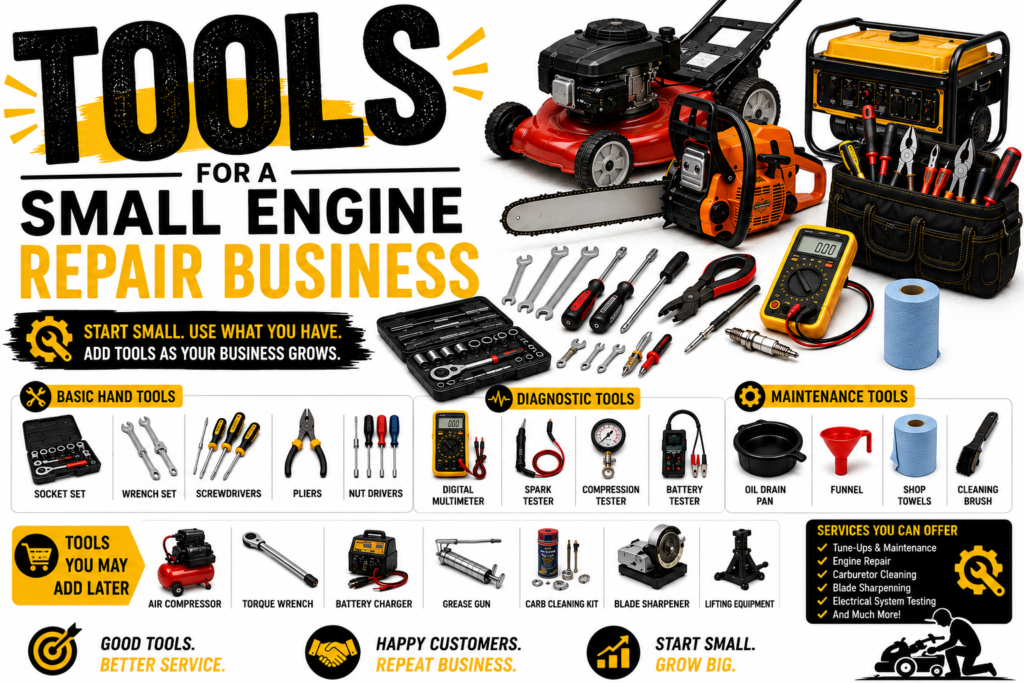
You do not need thousands of dollars in tools to start a small engine repair business.
If you already know how to work on lawn mowers, generators, chainsaws, snow blowers, string trimmers, leaf blowers, pressure washers, or other small engines, you may already have many of the tools you need.
The biggest mistake a new repair business can make is spending a lot of money on tools and equipment before finding customers.
You do not need to do that.
You can start with basic tools, take on the repairs you know how to do, earn money, and then use some of that money to buy additional tools.
This guide explains the tools you may need for a small engine repair business, which tools are important when you are starting, which tools can wait, and how to build your tool collection without spending money you do not have.
Do You Really Need a Lot of Tools?
No.
You need the right tools for the jobs you plan to perform.
If you are starting with lawn mower tune-ups, for example, you may not need the same tools as someone rebuilding engines or repairing advanced electrical systems.
Start with the work you understand.
Then buy additional tools as your customers begin asking for more services.
Do not build a $10,000 repair shop before you have your first customer.
Start With the Tools You Already Have
Before you buy anything, look around your garage, workshop, basement, or storage area.
You may already have many useful tools.
Common tools include:
- Screwdrivers
- Wrenches
- Socket sets
- Pliers
- Hammers
- Allen keys
- Utility knives
- Work lights
- Tape measures
- Basic hand tools
If you have worked on cars, motorcycles, lawn equipment, farm equipment, or other machines, you may already have a good starting collection.
You do not need to replace perfectly good tools simply because you are starting a business.
Your Skills Are More Important Than Your Tools
A tool does not know how to diagnose a problem.
You do.
A person with a basic set of tools and good mechanical knowledge can often do more useful work than someone with thousands of dollars in equipment but little experience.
Your ability to find a problem and fix it is what customers are paying for.
Your skills are the foundation of your business.
Basic Hand Tools
Basic hand tools should be the first part of your small engine repair tool collection.
Socket Set
A socket set is useful for removing and installing nuts and bolts on many types of equipment.
A combination of standard and metric sizes can be useful because different machines use different fasteners.
You do not necessarily need the most expensive professional socket set when you are starting.
Wrench Set
A set of combination wrenches is another basic requirement.
Wrenches are useful when a socket cannot reach a fastener or when working in tight areas.
Screwdriver Set
You should have several sizes of flat-head and Phillips screwdrivers.
Some small engines use screws in places that are difficult to reach, so having different sizes and lengths can make the job easier.
Pliers
A basic selection of pliers can handle many repair jobs.
Useful types include:
- Standard pliers
- Needle-nose pliers
- Slip-joint pliers
- Locking pliers
Nut Drivers
Nut drivers can be useful when working on small engines and small equipment.
You do not need every size when you start.
Buy sizes that match the equipment you repair most often.
Tools for Diagnosing Small Engine Problems
Good diagnosis is one of the most important parts of a repair business.
You do not want to replace parts simply because you think they might be bad.
Testing can help you find the real problem.
Digital Multimeter
A digital multimeter can help you test electrical systems.
Depending on the equipment, you may use it to check voltage, continuity, resistance, and other electrical measurements.
A multimeter can be especially useful when working on generators, riding lawn mowers, electric-start equipment, golf carts, and other machines with electrical systems.
Spark Tester
A spark tester can help you determine whether an ignition system is producing spark.
This can be useful when an engine will not start.
It is a relatively simple tool that can help you avoid guessing.
Compression Tester
A compression tester can help you check the condition of an engine.
Low compression can indicate an internal engine problem.
Follow the manufacturer’s procedures when performing a compression test.
Battery Tester
A battery tester can be useful when working on equipment with batteries.
This can include riding lawn mowers, generators, golf carts, ATVs, and other equipment.
Testing the battery before replacing it can save both you and your customer money.
Oil Change Tools
If you plan to offer tune-ups and routine maintenance, you will need basic oil service equipment.
This may include:
- Oil drain pan
- Funnel
- Oil containers
- Basic wrenches
- Shop towels
Always use the oil type and amount recommended by the equipment manufacturer.
Used oil should be stored and disposed of according to applicable local requirements.
Tools for Cleaning Small Engines
Cleaning is often part of small engine repair.
Dirt, grass, dust, grease, and other debris can make it harder to inspect equipment.
Basic cleaning supplies may include:
- Small brushes
- Shop towels
- Parts-cleaning containers
- Cleaning products appropriate for the equipment
- Compressed air where appropriate
A clean work area also makes it easier to keep track of small parts.
A Good Work Light
Small engines often have parts hidden in dark or difficult-to-reach areas.
A good work light can make your job easier.
A rechargeable portable light can be especially useful if you plan to offer mobile repair.
You do not need an expensive lighting system.
A bright, dependable work light can be enough to get started.
Torque Wrench
A torque wrench allows you to tighten certain fasteners to the manufacturer’s recommended specification.
This can be important for parts where proper tightening matters.
Use the manufacturer’s service information for the correct torque specifications.
A torque wrench may not be the first tool you buy, but it can become an important part of your shop as you take on more repairs.
Battery Charger
A battery charger can be useful if you work on equipment with rechargeable batteries.
Different batteries require different charging methods.
Use a charger that is appropriate for the battery and follow the manufacturer’s instructions.
Fuel System Tools and Supplies
Fuel problems are common with small engines, especially equipment that has been sitting for a long time.
Depending on the services you offer, you may need supplies for:
- Fuel line replacement
- Fuel filter replacement
- Carburetor cleaning
- Fuel system inspection
- Fuel container handling
Always use safe fuel-handling practices and follow applicable storage requirements.
Tools for Lawn Mower Repair
If lawn mower repair is one of your main services, you may eventually need additional tools.
These may include:
- Blade removal tools
- Blade sharpening equipment
- Grease gun
- Air pressure gauge
- Appropriate lifting equipment
- Deck cleaning tools
You do not need all of these tools on your first day.
Buy them when the work you are getting requires them.
Tools for Riding Lawn Mower Repair
Riding lawn mowers are larger and heavier than push mowers.
They may require additional equipment such as:
- Appropriate lifting equipment
- Jack stands or other suitable support equipment
- Larger socket sizes
- Belt tools
- Battery testing equipment
- Grease equipment
Never work underneath heavy equipment unless it is properly supported using equipment designed for the job.
Tools for Chainsaw Repair
Chainsaw repair may require some specialized tools.
Depending on the work you perform, these may include tools for:
- Chain maintenance
- Bar maintenance
- Sprocket inspection
- Carburetor service
- Fuel system service
Chainsaws can cause serious injuries if handled improperly.
Follow the manufacturer’s repair and safety procedures.
Tools for Generator Repair
Generators may require both engine and electrical diagnosis.
Useful tools can include:
- Digital multimeter
- Battery tester
- Spark tester
- Compression tester
- Socket set
- Wrench set
- Work light
If you are not comfortable working on electrical systems, limit your services to repairs you understand and can perform safely.
Tools for Pressure Washer Repair
Pressure washers combine a small engine with a pump and water system.
Depending on the repair, you may need basic engine tools along with tools for inspecting hoses, fittings, nozzles, and other components.
You do not need to offer pump repairs when you first start.
You can begin with the engine and maintenance work you already understand.
Tools for Mobile Small Engine Repair
If you plan to provide mobile repair, organization becomes very important.
You may want:
- Portable toolbox
- Tool bags
- Parts containers
- Portable work light
- Battery charger
- Shop towels
- Common replacement parts
- Small storage containers
You do not need to carry your entire workshop in your vehicle.
Carry the tools you use most often.
Buy Tools Based on Customer Demand
This is one of the most important rules for starting a repair business with little money.
Do not buy an expensive tool simply because you think you might need it someday.
Wait until customers start asking for a service that requires the tool.
For example, if several customers ask you to perform a repair that requires a specialized tool, buying that tool may now make financial sense.
Let the business pay for the tools.
New Tools vs. Used Tools
You do not always need to buy brand-new tools.
Used tools can sometimes save you money.
Check used tools carefully before buying them.
Make sure they are in safe working condition and are appropriate for the work you plan to perform.
For tools where accuracy or safety is especially important, buying a good-quality new tool may be worth the extra cost.
Do Not Always Buy the Cheapest Tool
Saving money is important when starting a business.
However, the cheapest tool is not always the best deal.
A tool that breaks quickly may cost more because you have to buy another one.
Look for a reasonable balance between price, quality, durability, and the type of work you perform.
Tools You Can Buy Later
You may eventually want many specialty tools.
But you probably do not need them at the beginning.
Tools and equipment that can often wait include:
- Large shop machinery
- Expensive diagnostic equipment
- Industrial compressors
- Large lifts
- Specialized equipment for rare repairs
- Large parts inventories
Buy these items when your business has enough work to justify them.
Create a Basic Starter Tool List
If your budget is limited, start with the basics.
A simple starter collection might include:
- Socket set
- Wrench set
- Screwdriver set
- Pliers
- Nut drivers
- Digital multimeter
- Spark tester
- Compression tester
- Work light
- Oil drain pan
- Basic cleaning supplies
- Toolbox
This does not have to be your final tool collection.
It is simply a starting point.
Keep Your Tools Organized
Organization can save you time.
If you spend ten minutes looking for a tool during every repair, that lost time can add up.
Use a toolbox, tool bag, drawers, labels, or another simple system that works for you.
Put your tools back in the same place after each job.
Take Care of Your Tools
Your tools are business equipment.
Take care of them.
- Keep them clean.
- Keep them dry.
- Store them properly.
- Inspect them regularly.
- Replace damaged tools.
A good tool can last for many years when it is properly maintained.
Protect the Customer’s Equipment
Your responsibility is not only to protect your tools.
You also need to protect the customer’s equipment.
Use appropriate procedures when working on engines, fuel systems, electrical components, blades, and other parts.
Keep track of small parts and clean the work area when you finish.
What If You Have Almost No Money?
You can still start small.
Look at the skills you already have and the tools you already own.
Choose a simple service that you can perform with those tools.
For example, you might begin with:
- Oil changes
- Spark plug replacement
- Air filter replacement
- Basic inspections
- Carburetor cleaning
- Basic tune-ups
Then use some of your first earnings to buy the next tool you need.
You do not have to borrow thousands of dollars to get started.
Do Not Go Into Debt Just to Look Professional
A fancy shop does not automatically make you a good mechanic.
A large collection of expensive tools does not automatically bring customers.
Customers come back because you solve their problems and treat them fairly.
If money is tight, protect your money.
Keep your business expenses low.
Grow when the business gives you a reason to grow.
Your Knowledge Can Be Worth More Than Your Tools
Think about what the customer is actually paying for.
They are not paying you because you own a screwdriver.
They are paying because you know what to do with the screwdriver.
A customer may have spent hours trying to get a lawn mower started.
You may be able to identify the problem quickly.
Your knowledge, experience, and ability to solve the problem have value.
What If You Are Retired?
If you are retired and have years of experience working with tools and machines, you may already have most of what you need to begin.
You do not have to build a huge business.
You can take a limited number of customers and work when you want.
You can use the skills you already have to earn additional income.
What If You Do Not Like Resumes and Job Interviews?
Some people would rather work with their hands than spend their time filling out job applications, writing resumes, and sitting through interviews.
A small repair business can provide another possible way to use your skills.
You do not need to convince an employer that you are qualified.
You need to show customers that you can solve their problems.
What If You Have a Criminal Record?
A criminal record can make traditional employment more difficult for some people.
Self-employment can provide another possible path for someone who has useful skills and wants to work.
Your customers may care about whether you provide dependable service, communicate honestly, and take care of their equipment.
You still need to follow all applicable laws, licensing requirements, insurance requirements, and other rules in your area.
Keep Track of Your Tool Expenses
Keep records of the tools and equipment you purchase for your business.
Record information such as:
- Date purchased
- Tool name
- Purchase price
- Where you purchased it
- How the tool is used in your business
Good records can help you understand where your business money is going.
Follow applicable tax rules for business expenses.
Build Your Tool Collection Slowly
Your tool collection should grow along with your business.
A simple approach is:
- Use the tools you already have.
- Start with simple services.
- Find your first customers.
- Earn money.
- Buy the next useful tool.
- Add another service.
- Find more customers.
- Repeat the process.
This approach can help you avoid spending money you do not have.
Is Starting a Small Engine Repair Business Possible With Little Money?
It can be.
You do not need every tool on the market.
You do not need a huge shop.
You do not need a large inventory of parts.
You need a useful skill, basic tools, customers with problems, and a willingness to do good work.
Start with what you have.
Do not be afraid to start small.
Your first customer does not care how many tools are hanging on your wall. They care whether you can solve their problem.
Next Article Start a Small Engine Repair Business
Previous Article How to Start a Mobile Small Engine Repair Business
Related Articles
If you are interested in starting a small repair business, these related guides may also help:
- Start a Small Engine Repair Business
- Lawn Mower Repair Business
- Snow Blower Repair Business
- Chainsaw Repair Business
- String Trimmer Repair Business
- Leaf Blower Repair Business
- Generator Repair Business
- Pressure Washer Repair Business
- Riding Lawn Mower Repair Business
- Go-Kart Repair Business
- Golf Cart Repair Business
- ATV Repair Business
- Small Engine Tune-Up Service
- Mobile Small Engine Repair Business