
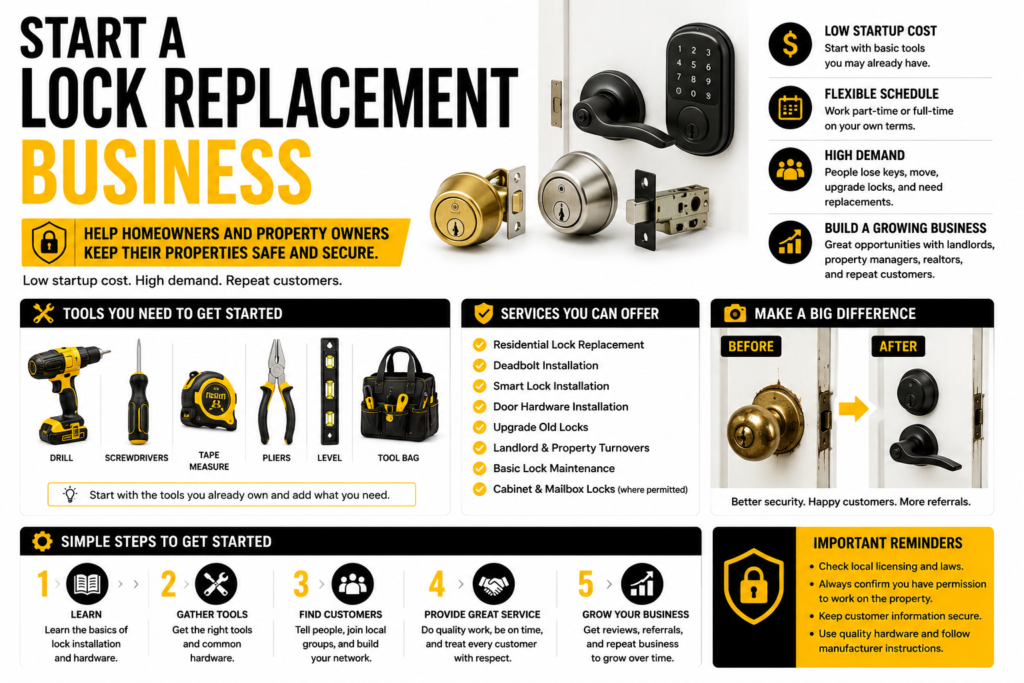
If you are good with tools and enjoy fixing things around homes, a lock replacement business may be a way to turn your skills into income.
People lose keys, move into new homes, replace old locks, upgrade their doors, and need damaged locks replaced. Landlords and property managers may also need locks changed between tenants.
That creates a simple business opportunity.
You provide a service that solves a problem the customer needs fixed.
A lock replacement business can be started relatively small. You may be able to work from home, travel to customers, and begin with a basic collection of tools and common replacement hardware.
This guide explains how to start a lock replacement business, what services you can offer, what tools you may need, how to find customers, how to set prices, and how to grow the business.
What Is a Lock Replacement Business?
A lock replacement business installs new locks and replaces existing residential or approved commercial door hardware.
Depending on your skills, training, licensing, and local laws, services may include:
- Replacing residential door locks
- Installing deadbolts
- Replacing worn door hardware
- Installing smart locks
- Replacing cabinet or mailbox locks where permitted
- Replacing locks for landlords
- Changing locks between tenants
- Installing door hardware
- Upgrading older locks
- Basic lock maintenance
You should only perform services that you are legally permitted and properly qualified to perform in your area.
Start with straightforward replacement and installation work that you understand.
Why Start a Lock Replacement Business?
Locks wear out.
Keys get lost.
People move into new homes.
Landlords prepare properties for new tenants.
Homeowners may want to upgrade older locks.
These situations create demand for lock replacement and installation services.
You are solving a problem that the customer usually wants solved quickly.
You Can Start Small
You do not necessarily need a storefront.
A mobile service can allow you to travel to customers and carry your tools and replacement hardware in your vehicle.
You Can Start With Basic Tools
Many residential lock replacement jobs require basic hand tools and installation equipment.
If you already have experience with home repairs, you may already own some of the tools.
You Can Work Part-Time
You can begin with a few jobs each week.
This lets you test the market without immediately making the business your full-time income.
You Can Build Repeat Business
Landlords, property managers, real estate professionals, and maintenance companies may need lock replacement services repeatedly.
Repeat customers can be valuable to a small business.
Check Your Local Rules Before You Start
Lock and locksmith work can be regulated differently depending on where you live.
Some locations may require a business license, locksmith license, registration, background check, insurance, or other requirements.
Before advertising your services, check the rules that apply in your city, county, and state.
Do not assume that every lock-related service is legal to perform without a license.
If your area requires a licensed locksmith for certain services, make sure you meet the requirements or limit your business to services you are legally allowed to provide.
Start With Lock Replacement Instead of Emergency Entry
There is an important difference between replacing a lock and gaining entry to a locked property.
A beginner may want to focus on legitimate replacement and installation services rather than emergency lockout work.
That can keep your business model simpler.
You can replace an existing lock when the customer has lawful access to the property and the work is within your legal scope.
Basic Tools You May Need
Your exact tool list depends on the hardware you install.
Basic tools may include:
- Screwdriver set
- Drill
- Drill bits
- Tape measure
- Pencil
- Level
- Pliers
- Wrench set
- Socket set
- Utility knife
- Flashlight or work light
- Small tool bag
You may need specialized tools for certain hardware.
Do not buy expensive specialty equipment until you have customers who need the service.
Start With the Tools You Already Own
Before spending money, look through your toolbox.
You may already have a drill, screwdrivers, pliers, level, tape measure, and other basic tools.
Make a list of what you have.
Then buy only the tools needed for your first services.
Keep your startup costs low.
Learn About Different Types of Locks
Residential doors can use different types of hardware.
Common examples include:
- Knob locks
- Lever locks
- Deadbolts
- Electronic locks
- Smart locks
- Entry door hardware
Learn how each type is installed before offering it as a service.
Follow the manufacturer’s instructions for the specific product.
Measure Before Buying Replacement Hardware
One of the easiest ways to waste time and money is to buy the wrong replacement lock.
Before purchasing hardware, determine what type and size of replacement is required.
Depending on the door and lock, you may need to check measurements such as:
- Door thickness
- Backset
- Hole size
- Existing mounting locations
- Lock configuration
Check the manufacturer’s specifications for the product you plan to install.
Keep a Small Inventory
When you are starting, you do not need a truck full of locks.
Keep a small inventory of common replacement hardware if it makes financial sense.
You can also purchase specific hardware after confirming what the customer needs.
This reduces the amount of money tied up in inventory.
Offer Residential Lock Replacement
Residential lock replacement can be a straightforward service for a business that focuses on legitimate installation work.
Customers may need locks replaced because:
- The lock is worn out.
- The lock is damaged.
- They moved into a new home.
- They want to upgrade the hardware.
- They want a different type of lock.
Always confirm that the customer has lawful authority to request the work.
Work With Landlords
Landlords can be an excellent source of repeat business.
Locks may need to be replaced when tenants move out or when hardware becomes damaged.
Introduce yourself to local landlords and explain the services you provide.
If you become dependable, a landlord may call you whenever another property needs lock replacement.
Work With Property Managers
Property managers may oversee many rental properties.
That can create ongoing demand for maintenance and hardware replacement.
Contact local property management companies and explain what services you offer.
Focus on being reliable and easy to work with.
Work With Realtors
Real estate agents may have customers who want locks changed after purchasing a home.
New homeowners often want to replace existing locks so they know who has access to the property.
Build relationships with local real estate professionals and explain your services.
Work With Home Repair Companies
Other home repair businesses may encounter customers who need locks or door hardware replaced.
Handymen, painters, contractors, property maintenance companies, and other businesses may be able to refer customers to you.
Make sure any referral arrangement follows applicable laws and business rules.
How to Find Your First Customers
You do not need a huge advertising budget.
Start close to home.
Tell People You Know
Tell friends, family members, neighbors, and other people you know about your business.
Be specific about what you do.
You could say:
“I provide residential lock replacement and door hardware installation in the local area.”
This is clearer than simply saying you are a handyman.
Use Local Community Groups
Local community groups can help you reach homeowners and landlords.
Keep your advertisement simple.
Explain:
- What services you offer
- What area you serve
- Whether you work by appointment
- What types of locks you install
- How customers can contact you
Build a Simple Website
A basic website can help people understand your service.
Your website should clearly explain what you do and how customers can contact you.
Include photographs of your own completed work when possible.
How Much Should You Charge?
Your pricing should cover more than the price of the replacement lock.
You are also providing:
- Labor
- Knowledge
- Tools
- Travel
- Installation
- Business expenses
- Customer service
Flat-Rate Installation
A flat installation price can make it easy for customers to understand what they will pay.
You can have different prices for different types of installations.
Service Call Fee
If you travel to the customer’s property, a service or trip fee can help cover your travel expenses.
Tell customers about the fee before the appointment.
Parts and Hardware
Charge appropriately for the hardware you supply.
Keep track of your purchase costs so you know whether your pricing is profitable.
Do Not Underprice Your Work
A common mistake for new business owners is charging too little.
The customer may see you install a lock in 30 minutes.
They may not see the time you spent learning the skill, buying tools, purchasing hardware, traveling to the property, and handling the business paperwork.
Your skill and time have value.
Set a Minimum Service Charge
A minimum service charge can make sense for a mobile business.
Even a small installation requires travel, setup, work, cleanup, and administration.
Your minimum charge should cover the total cost of providing the service.
Do Not Promise Emergency Service Unless You Are Ready
Emergency service can be demanding.
Customers may expect you to arrive immediately, day or night.
If you are starting part-time, you may want to offer scheduled appointments instead.
You can add emergency services later if you decide they fit your business and you meet all applicable requirements.
Smart Locks Can Create Another Service
Smart locks are becoming more common in homes.
Some homeowners may want to replace traditional locks with electronic or smart locks.
If you understand these products, you may be able to add smart-lock installation to your services.
Follow the manufacturer’s installation instructions and make sure the product is appropriate for the customer’s door.
Protect Customer Information
Lock-related businesses can involve sensitive information about a customer’s home and security.
Do not share customer addresses, access information, photographs, or other private information without permission.
Keep customer records secure.
Only collect information that you actually need to provide the service.
Safety and Security Matter
A lock is part of a property’s security.
Take your work seriously.
Install hardware correctly.
Follow the manufacturer’s instructions.
Do not make promises about security that you cannot support.
If you discover a problem with the door or frame that affects the installation, tell the customer.
Can You Start Part-Time?
Yes.
A lock replacement business can be operated part-time if your local rules allow it.
You can schedule customers during evenings, weekends, or other times that work for you.
This can allow you to test the business before making it your full-time income.
What If You Are Retired?
If you enjoy working with tools and want a flexible way to earn additional income, lock replacement may be worth considering.
You can decide how many appointments you want to accept.
You can also choose which services you are comfortable providing.
What If You Do Not Like Resumes and Job Interviews?
Some people would rather work with their hands than spend their time applying for traditional jobs.
A service business can provide another possible way to earn money from a useful skill.
A homeowner has a damaged or outdated lock.
You know how to replace it.
You provide the service and get paid for solving the problem.
You are building a business around a skill instead of looking for someone to hire you.
What If You Have a Criminal Record?
A criminal record can make traditional employment more difficult for some people.
Self-employment can provide another possible path for someone with useful skills who wants to work.
However, because lock and locksmith work can involve security-related services, licensing and background-check requirements may apply in some locations.
Check your local laws before starting the business.
Keep Good Records
Good records are important for any small business.
For each job, record:
- Customer name
- Contact information
- Service address
- Type of lock
- Hardware installed
- Labor performed
- Materials used
- Price quoted
- Payment received
Also keep records of your business expenses and follow applicable tax requirements.
Common Mistakes to Avoid
Buying Too Much Inventory
Do not spend thousands of dollars stocking every type of lock.
Start with common products and purchase special hardware when customers need it.
Ignoring Local Licensing Rules
Lock-related services can be regulated.
Check your local requirements before advertising.
Installing the Wrong Hardware
Measure the door and verify compatibility before buying or installing a replacement lock.
Undercharging
Remember to include travel, labor, tools, business expenses, and your time in your pricing.
Taking Work Outside Your Skill Level
Do not accept a job simply because someone offers to pay you.
If you do not understand the installation or the hardware, refer the customer to someone qualified.
How to Grow a Lock Replacement Business
You can grow the business gradually.
A possible path could look like this:
- Start with basic residential lock replacement.
- Build customer reviews.
- Develop relationships with landlords.
- Contact property managers.
- Build relationships with realtors.
- Add smart-lock installation.
- Add additional door hardware services.
- Offer commercial services if properly licensed and qualified.
- Expand your service area.
- Hire help when the workload justifies it.
You do not have to follow this exact path.
Build around the services customers in your area actually need and the work you are legally permitted to perform.
Is a Lock Replacement Business Right for You?
If you enjoy working with tools, solving problems, and helping homeowners maintain their property, a lock replacement business may be worth considering.
You can start small.
You can use tools you already own.
You can work part-time.
You can build relationships with landlords and property managers.
Then you can add services as your skills and customer base grow.
You do not need a large investment to start solving everyday problems for customers.
Start with the skills you have, keep your costs under control, do good work, and build your business one customer at a time.
Next Article How to Start a Weatherstripping Business
Previous Article How to Start a TV Mounting Business
Related Articles
If you are interested in starting a home repair or installation business, these related guides may also help: