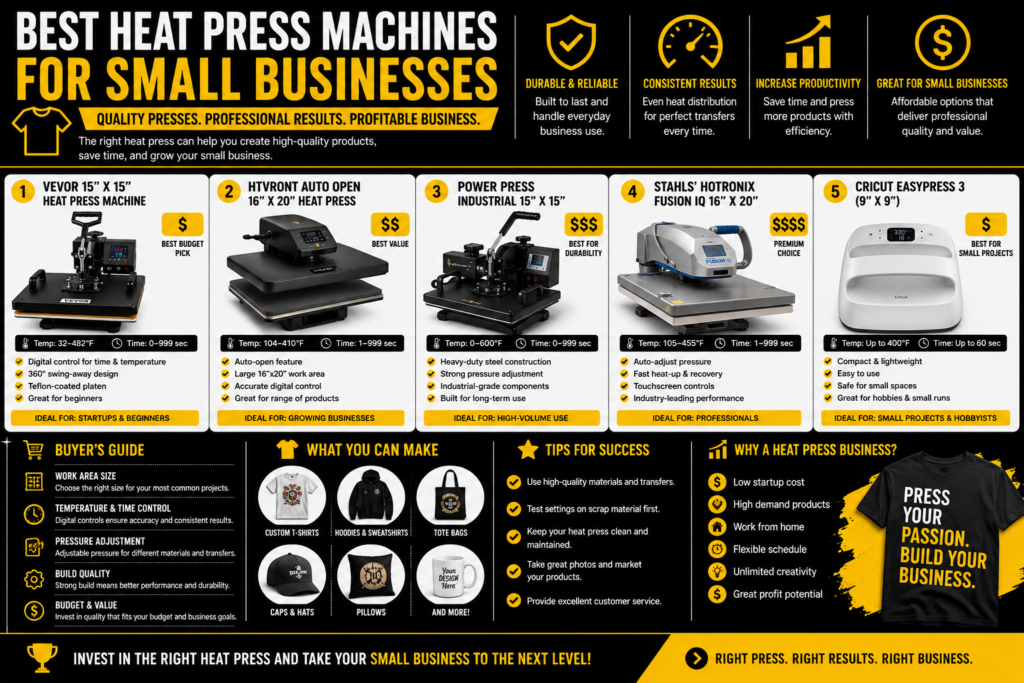
Choosing the right heat press machine is one of the most important decisions you’ll make when starting a T-shirt printing business. A quality heat press produces consistent results, reduces costly mistakes, and helps create professional-looking apparel that customers will be happy to wear.
The good news is that you don’t need to spend thousands of dollars on commercial equipment to get started. Many small business owners begin with an affordable heat press and upgrade as their customer base grows.
If you’re still deciding whether a T-shirt printing business is right for you, start with our guide on How to Start a Small Manufacturing Business before investing in equipment.
Read More: How to Start a Small Manufacturing Business
What Is a Heat Press Machine?
A heat press uses controlled heat and pressure to permanently apply designs to T-shirts, hoodies, hats, tote bags, and other products.
Depending on your production method, a heat press can be used with:
- Heat Transfer Vinyl (HTV)
- Direct-to-Film (DTF) transfers
- Sublimation transfers
- Printable heat transfers
- Specialty vinyl
For many beginners, a heat press is the first major equipment purchase.
Why Your Heat Press Matters
A quality machine provides:
- Even heat distribution
- Consistent pressure
- Accurate temperature control
- Reliable production
- Better-looking finished products
- Fewer ruined garments
Buying the cheapest machine available often leads to uneven heating, wasted materials, and unhappy customers.
Types of Heat Press Machines
Clamshell Heat Press
The upper platen opens like a clam shell.
Pros
- Takes up less space
- Easy to use
- Great for beginners
- Usually more affordable
Cons
- Less room for positioning garments
Best For: Home-based businesses and beginners.
Swing-Away Heat Press
The heating element swings completely away from the work surface.
Pros
- More workspace
- Even pressure
- Easier garment placement
Cons
- Requires more room
- Typically costs more
Best For: Businesses expecting regular production.
Draw Heat Press
The lower platen slides out toward the operator.
Pros
- Safer to use
- Easier garment placement
- Less chance of accidental burns
Cons
- Higher purchase price
Best For: Small businesses focused on efficiency.
What Size Heat Press Should You Buy?
For most startups, a 15″ x 15″ or 16″ x 20″ heat press offers the best balance between price and versatility.
Smaller presses work well for hats, sleeves, and children’s apparel, while larger presses make it easier to decorate hoodies and oversized shirts.
Features to Look For
When comparing heat presses, look for:
- Digital temperature controls
- Digital timer
- Adjustable pressure
- Even heating
- Solid steel construction
- Replaceable heating element
- Reliable warranty
- Good customer support
These features improve production quality and reduce maintenance issues.
How Much Should You Spend?
Your budget depends on your business goals.
Entry-Level
Estimated Price: $300–$600
Suitable for:
- Hobby businesses
- Part-time operations
- Learning the trade
Mid-Range
Estimated Price: $600–$1,200
Suitable for:
- Growing businesses
- Frequent production
- Better durability
Commercial
Estimated Price: $1,200+
Suitable for:
- High-volume production
- Full-time businesses
- Commercial print shops
Start with equipment that matches your current workload instead of buying more machine than you need.
Other Equipment You’ll Need
A heat press is only part of your setup.
You’ll also need:
- Computer
- Graphic design software
- Vinyl cutter (for HTV)
- DTF transfers or HTV
- Blank apparel
- Teflon sheets
- Heat-resistant tape
- Weeding tools
- Packaging supplies
- Shipping scale
Common Mistakes to Avoid
Many beginners’ waste money by making these mistakes:
- Buying the cheapest machine available
- Purchasing commercial equipment before getting customers
- Ignoring warranty coverage
- Buying the wrong size press
- Forgetting to budget for supplies
- Not practicing before accepting customer orders
Quality equipment is an investment, but experience and customer service are what build a successful business.
Which Heat Press Is Best for Beginners?
For most new business owners, a quality 15″ x 15″ clamshell heat press offers the best value. It provides enough space for most apparel projects while keeping startup costs manageable.
As your business grows, you can upgrade to a larger swing-away or commercial heat press to increase production capacity.
Related Articles
- Read More: How to Start a Small Manufacturing Business
- Read More: How to Start a T-Shirt Printing Business
- Read More: How to Start a Vinyl Decal Business
- Read More: How to Start an Embroidery Business
- Read More: How to Start a Custom Sticker Business
Frequently Asked Questions
What size heat press is best for beginners?
A 15″ x 15″ heat press is the most popular choice because it works for most T-shirt sizes while remaining affordable.
Is a cheap heat press worth buying?
Very inexpensive machines may work for occasional use, but investing in a quality model usually provides more consistent results and fewer production problems.
Can one heat press work with HTV and DTF?
Yes. Most modern heat presses can be used with Heat Transfer Vinyl, Direct-to-Film transfers, sublimation, and other heat-applied products by adjusting the temperature, pressure, and pressing time.
How long does a heat press last?
A quality heat press can last for many years with proper maintenance and regular use.
Do I need a heat press to start a T-shirt printing business?
If you’re using HTV, DTF, sublimation, or heat transfers, a heat press is an essential piece of equipment.
Can I use a household iron instead?
A household iron doesn’t provide consistent heat or pressure and isn’t recommended for producing professional-quality products.
Final Thoughts
The best heat press machine isn’t necessarily the most expensive one—it’s the one that fits your budget, production goals, and business stage. Starting with dependable equipment allows you to learn the business, produce quality products, and grow confidently without overspending.
As your customer base expands, you can always upgrade your equipment. Focus first on delivering outstanding products and exceptional customer service and let your business grow one satisfied customer at a time.