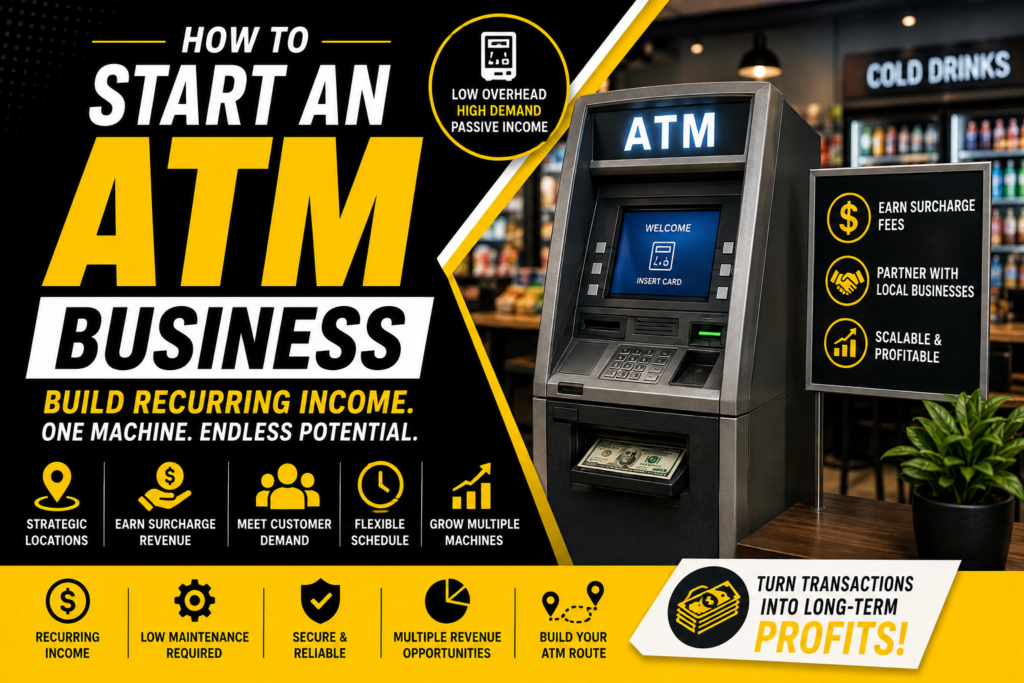
An ATM business can be an excellent way to generate recurring income with relatively low day-to-day involvement. Instead of selling products or providing services directly, ATM owners earn money each time customers withdraw cash from one of their machines. Once an ATM is installed in a busy location, it can produce steady income for years with regular maintenance and cash replenishment.
Many entrepreneurs start with a single ATM and expand their business by placing additional machines in convenience stores, gas stations, hotels, bars, restaurants, laundromats, and other high-traffic locations. As revenue grows, owners often purchase more machines and build profitable routes that can eventually generate semi-passive income.
This guide explains everything you need to know about starting an ATM business, including startup costs, equipment, finding locations, legal requirements, and strategies for maximizing profits.
What Is an ATM Business?
An ATM (Automated Teller Machine) business involves purchasing ATM machines and placing them inside businesses where customers need convenient access to cash. Every time someone withdraws money, the ATM owner typically earns a surcharge fee.
Many locations benefit from having an ATM because customers often spend more money after withdrawing cash. This creates a win-win situation for both the location owner and the ATM operator.
Typical ATM locations include:
- Convenience stores
- Gas stations
- Restaurants
- Bars and nightclubs
- Hotels
- Laundromats
- Shopping centers
- Liquor stores
- Smoke shops
- Arcades
- Entertainment venues
- Casinos (where permitted)
How Does an ATM Business Make Money?
The primary source of revenue comes from surcharge fees charged to customers using the ATM. Every withdrawal generates a fee that is paid directly to the ATM owner or shared with the business hosting the machine.
For example:
- Surcharge fee: $3.50
- Monthly transactions: 500
- Monthly gross income: $1,750
Some business owners negotiate a revenue-sharing agreement with the property owner, while others pay a fixed monthly rental fee for the machine location.
Why Start an ATM Business?
ATM businesses continue to attract entrepreneurs because they offer recurring revenue and can often be managed alongside another job or business.
Advantages include:
- Recurring monthly income
- No storefront required
- Flexible schedule
- Relatively low operating expenses
- Easy to expand
- Can be managed part-time
- High demand in cash-heavy businesses
- Scalable by adding more machines
While digital payments continue to grow, many businesses still rely heavily on cash transactions, making strategically placed ATMs valuable to both merchants and customers.
How Much Does It Cost to Start an ATM Business?
Startup costs vary depending on whether you purchase new or used machines and how many ATMs you plan to install.
| Expense | Estimated Cost |
|---|---|
| ATM Machine | $2,000–$8,000 |
| Cash Inventory | $2,000–$10,000+ |
| Business Registration | $100–$500 |
| Insurance | $300–$1,000 per year |
| Processing Setup | $100–$500 |
| Vehicle & Fuel | Varies |
Many entrepreneurs begin with one ATM and reinvest profits into purchasing additional machines.
Equipment You’ll Need
Starting an ATM business doesn’t require a large amount of equipment, but reliable machines and proper tools are essential.
- ATM machine
- Cash loading trays
- Security keys
- Business vehicle
- Smartphone
- Accounting software
- GPS navigation
- Basic repair tools
- Receipt paper
- Cleaning supplies
Many owners also use route management software to organize service schedules and reduce travel time between locations.
Choosing the Right ATM Machine
Not every ATM is the same. Selecting the right machine can improve reliability, reduce maintenance costs, and provide a better customer experience.
When comparing machines, look for:
- EMV chip compliance
- Contactless payment support
- Large cash cassette capacity
- Remote monitoring capability
- Easy receipt paper replacement
- Strong security features
- ADA compliance
- Reliable manufacturer support
Buying from an established ATM supplier often includes technical support and software updates that can save time and reduce downtime.
Finding Profitable ATM Locations
The location of your ATM is the single biggest factor in determining profitability. A machine placed in a busy business can generate hundreds of transactions each month, while a poorly chosen location may receive very little use.
Look for businesses with:
- High daily foot traffic
- Frequent cash transactions
- Limited nearby ATM access
- Evening or weekend customers
- Tourist activity
- Entertainment or nightlife
Before approaching a business owner, observe customer traffic during different times of the day and estimate how many people may need convenient access to cash.
Negotiating ATM Locations
Finding a great location is only half the battle. You’ll also need to convince business owners that installing your ATM benefits both their customers and their business. A professionally presented proposal can significantly improve your chances of securing high-quality locations.
Explain that an ATM can:
- Increase customer convenience
- Encourage larger purchases
- Reduce credit card processing fees when customers pay with cash
- Generate additional income through revenue sharing
- Keep customers from leaving to search for another ATM
Many ATM operators either pay the business owner a fixed monthly rental fee or offer a percentage of each surcharge collected. Revenue-sharing agreements are often attractive because both parties benefit as transaction volume increases.
Cash Management
Unlike many businesses, ATM operators must regularly replenish their machines with cash. Proper cash management is essential to keeping your ATMs operational and profitable.
Successful operators:
- Monitor cash levels remotely whenever possible.
- Refill machines before they run out of cash.
- Keep detailed records of deposits and withdrawals.
- Use secure procedures when transporting cash.
- Schedule refills during daylight hours whenever practical.
As your business grows, you may choose to hire armored cash services or work with financial institutions to manage larger cash inventories.
ATM Processing Companies
Every ATM requires a payment processor that connects the machine to banking networks. The processor authorizes transactions, manages electronic communication with banks, and transfers surcharge revenue.
When choosing an ATM processor, compare:
- Processing fees
- Monthly service charges
- Technical support availability
- Remote monitoring features
- Settlement times
- Reporting tools
- Software compatibility
A reliable processor minimizes downtime and helps ensure customers can complete transactions quickly and securely.
Legal Requirements and Business Licenses
Requirements vary by state, but most ATM businesses should obtain the following before operating.
- Business registration (LLC or Corporation)
- Employer Identification Number (EIN)
- Local business license (if required)
- Commercial insurance
- Business bank account
- Written agreements with location owners
Consult your state and local government to determine whether additional licensing or registration requirements apply to your business.
Insurance for an ATM Business
Insurance helps protect your investment against theft, vandalism, accidents, and liability claims.
Policies commonly considered include:
- General liability insurance
- Commercial property insurance
- Commercial vehicle insurance
- Crime or theft coverage
- Workers’ compensation insurance (if hiring employees)
Review your policy carefully to understand what is covered, especially when transporting cash or servicing machines at customer locations.
Marketing Your ATM Business
Although individual ATM users don’t choose your business directly, you still need marketing to secure profitable locations and build relationships with property owners.
Effective marketing strategies include:
- Create a professional website.
- Optimize your Google Business Profile.
- Network with local business owners.
- Join your Chamber of Commerce.
- Contact convenience stores and independent retailers.
- Visit businesses in person with a professional brochure.
- Request referrals from satisfied location owners.
- Build relationships with commercial property managers.
Most successful ATM operators grow through referrals and long-term relationships rather than traditional advertising.
How to Grow an ATM Business
One ATM can provide valuable experience, but long-term profitability usually comes from operating multiple machines.
Growth strategies include:
- Add additional ATM locations.
- Expand into neighboring cities.
- Purchase existing ATM routes.
- Upgrade older machines.
- Hire service technicians.
- Offer ATM placement services to businesses.
Many full-time operators manage dozens or even hundreds of machines across several cities.
Common Mistakes to Avoid
Avoiding these common mistakes can save money and improve profitability.
- Choosing low-traffic locations.
- Ignoring machine maintenance.
- Running out of cash.
- Failing to negotiate strong location agreements.
- Buying unreliable machines.
- Ignoring security procedures.
- Not tracking profitability by location.
- Expanding too quickly.
Successful ATM businesses focus on reliable equipment, excellent locations, and efficient route management.
Frequently Asked Questions
Is an ATM business profitable?
Yes. A well-placed ATM can generate recurring monthly income through surcharge fees. Profitability depends largely on location, transaction volume, operating costs, and the terms negotiated with the business owner.
How many ATM transactions are needed to make money?
The number varies based on your surcharge fee and expenses. Higher transaction volume generally leads to greater profits, making busy locations the key to long-term success.
Can I own multiple ATMs?
Absolutely. Most successful ATM business owners gradually expand by placing additional machines in new locations and building efficient service routes.
Do I need employees?
No. Many operators manage several ATMs themselves before hiring employees or outsourcing maintenance as the business grows.
Can an ATM business be operated part-time?
Yes. Many entrepreneurs begin with one or two machines while working another job. As revenue increases, they often expand into a full-time business.
Related Articles
- How to Start a Route-Based Business
- How to Start a Vending Machine Business
- How to Start an Ice Vending Business
- How to Start a Coffee Vending Business
- How to Start a Water Vending Business
- How to Start a Claw Machine Business
Continue Learning
Previous Article: How to Start a Vending Machine Business
Next Article: How to Start an Ice Vending Business
Final Thoughts
An ATM business offers an excellent opportunity to build recurring income with relatively low overhead and flexible working hours. By investing in reliable machines, choosing high-traffic locations, maintaining excellent relationships with business owners, and managing your cash responsibly, you can create a scalable business that continues to generate income for years.
Many successful ATM operators begin with a single machine and gradually expand into dozens of locations across multiple cities. With careful planning, strong customer relationships, and consistent service, an ATM business can become an attractive long-term investment and an important part of a profitable route-based business portfolio.