
If you know how to repair small engines, a string trimmer repair business can be a simple way to turn your skills into income. Homeowners, landscapers, property managers, and other people use string trimmers to keep grass and weeds under control. When a trimmer will not start or stops working, they need someone who can fix it.
You do not need a large shop or a lot of money to get started. If you already have basic tools and some mechanical experience, you may be able to start small and build the business as customers begin to find you.
This guide explains how to start a string trimmer repair business, what repairs you can offer, what tools you may need, how to find customers, how to charge for your work, and how to grow the business over time.
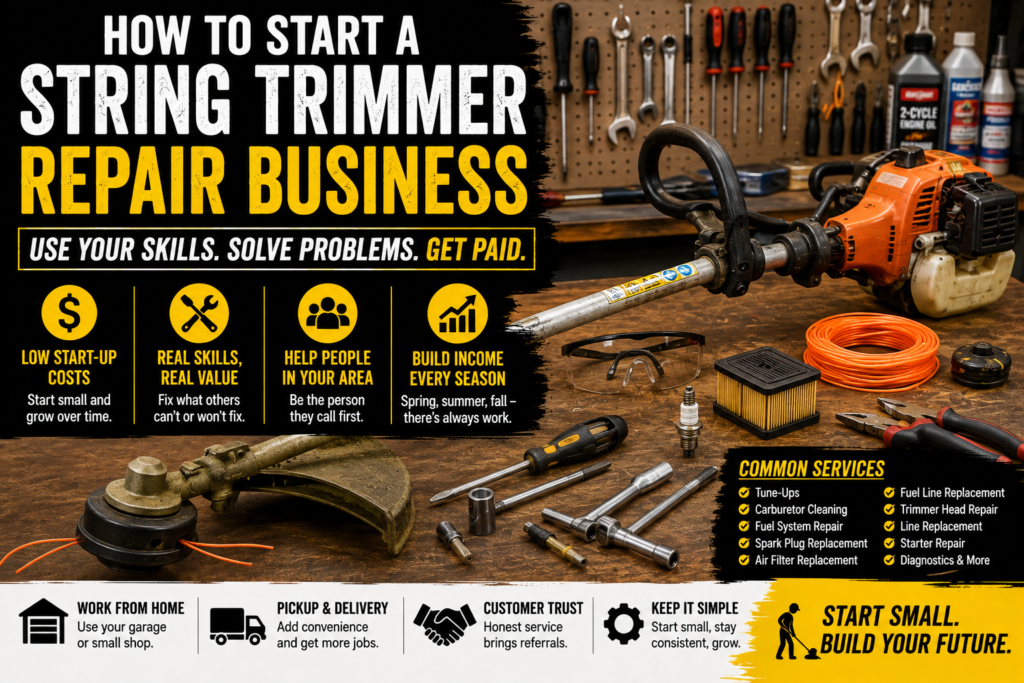
What Is a String Trimmer Repair Business?
A string trimmer repair business fixes and maintains gas-powered and, where appropriate, other types of string trimmers and related equipment.
Common repair and maintenance services may include:
- Fixing trimmers that will not start
- Cleaning or servicing carburetors
- Replacing spark plugs
- Replacing fuel lines
- Replacing fuel filters
- Replacing air filters
- Repairing starter systems
- Replacing trimmer heads
- Replacing cutting line
- Replacing worn parts
- Performing tune-ups
- Diagnosing engine problems
You do not need to offer every service when you begin. Start with the repairs you already understand and add services as your experience grows.
Why Start a String Trimmer Repair Business?
String trimmers are common pieces of lawn equipment. They are also machines that can develop problems through normal use, poor storage, old fuel, dirt, wear, and lack of maintenance.
That creates a simple business opportunity.
Someone has a broken machine. You have the skill to fix it.
You Can Start With Skills You Already Have
You may already know more than you think.
If you have repaired lawn mowers, chainsaws, motorcycles, generators, or other small engines, many of your skills can transfer to string trimmers.
You may have learned these skills at a job, from a family member, through military or trade experience, or simply by fixing your own equipment over the years.
A customer does not necessarily care where you learned the skill. They want their equipment working again.
You Can Start With Limited Money
You do not need to buy a building, hire employees, or purchase a large amount of inventory to test this business.
If you already have basic hand tools, you may only need a few additional tools and commonly used parts.
As the business earns money, you can put some of that money back into the business.
You Can Work From Home
If local rules allow it, a small repair business may be operated from a garage, shed, or workshop.
You can also consider pickup and delivery or mobile repair services.
Always check local rules before operating a repair business from your home.
How Much Does It Cost to Start?
There is no single startup cost for a string trimmer repair business.
Your cost depends on the tools you already own and the types of repairs you plan to offer.
Some basic expenses may include:
- Socket set
- Wrench set
- Screwdrivers
- Pliers
- Nut drivers
- Torque wrench
- Multimeter
- Spark tester
- Compression tester
- Work light
- Cleaning supplies
- Replacement spark plugs
- Fuel line
- Fuel filters
- Air filters
- Replacement trimmer line
You do not need to buy everything at once.
If money is limited, buy tools when you have a real reason to use them.
Start With the Tools You Have
One of the biggest mistakes a new business owner can make is spending too much money before getting customers.
You may see professional repair shops with thousands of dollars in equipment and think you need the same thing.
You do not.
Start with the tools needed for the jobs you plan to perform. Add better or specialized tools when the business can pay for them.
Common String Trimmer Problems
Learning how to diagnose common problems can help you build a useful repair service.
String Trimmer Will Not Start
This is one of the most common customer complaints.
The problem could involve old fuel, a dirty carburetor, a bad spark plug, a blocked fuel system, an ignition problem, or another engine issue.
Good diagnosis is important. Replacing random parts can cost both you and your customer money.
String Trimmer Starts and Dies
A trimmer that starts and then dies may have a fuel, carburetor, air, ignition, or adjustment problem.
The exact cause depends on the equipment.
Your job is to find the cause instead of simply guessing.
String Trimmer Runs Poorly
A trimmer that runs rough or lacks power may need maintenance or repair.
Possible areas to inspect include the air filter, fuel system, spark plug, carburetor, exhaust system, and other components.
Trimmer Head Problems
The cutting head can become damaged or worn.
You may be able to replace the trimmer head or other related components depending on the equipment.
Starter Problems
Pull-start systems can wear out or become damaged.
If you understand how these systems work, starter repair can become another service you offer.
String Trimmer Tune-Ups
A tune-up can be a useful service for customers who want to keep their equipment working properly.
Depending on the model and manufacturer’s recommendations, a tune-up may include:
- Checking or replacing the spark plug
- Inspecting the air filter
- Checking the fuel system
- Inspecting fuel lines
- Cleaning appropriate components
- Checking the cutting head
- Checking starter components
- Performing other recommended maintenance
A tune-up can also help you find problems before they become larger repairs.
Chain of Customers: One Repair Can Lead to More Work
A person who owns a string trimmer may also own a lawn mower, leaf blower, chainsaw, or snow blower.
This gives you an opportunity to sell more than one service to the same customer.
For example, a customer may bring you a string trimmer that will not start. While discussing the repair, they may mention that their lawn mower has also been sitting unused.
Now you may have two repair jobs instead of one.
Do not pressure customers. Simply let them know what other equipment you work on.
How to Find Your First Customers
Your first customers do not have to come from expensive advertising.
Start close to home.
Tell People You Know
Tell your neighbors, friends, family, former coworkers, and other people in your community that you repair string trimmers.
Be specific about what you do.
You could say:
“I repair string trimmers that won’t start, run poorly, or need maintenance.”
That tells people exactly what problem you solve.
Use Local Community Groups
Local online groups can be useful for a repair business.
Keep your advertisement simple.
Explain:
- What you repair
- What area you serve
- Whether you offer pickup and delivery
- How customers can contact you
Use Simple Flyers
You do not need an expensive marketing campaign.
A simple flyer could say:
STRING TRIMMER WON’T START?
REPAIR • TUNE-UPS • MAINTENANCE
Then list your service area and contact information.
Only place flyers where local rules allow advertising.
Work With Landscapers
Landscapers may be a valuable source of repeat business.
Someone who uses a string trimmer every day is likely to need maintenance and repairs more often than someone who uses one a few times each year.
You can introduce yourself to local landscaping businesses and explain what repair services you provide.
Do not expect every business to become a customer. You only need a few good relationships to create repeat work.
How Much Should You Charge?
Your prices should cover your costs and your time.
Remember that customers are paying for more than the replacement part.
They are paying for your:
- Knowledge
- Experience
- Diagnosis
- Labor
- Tools
- Time
Flat-Rate Pricing
You can charge a set price for simple services that are easy to estimate.
This may work well for certain tune-ups, chain or line replacement, and other basic services.
Hourly Labor
Complicated repairs may be easier to price by the amount of labor involved.
This can be useful when you do not know how long the repair will take.
Diagnostic Fee
You can charge a fee for diagnosing a problem.
Some repair businesses apply the diagnostic fee toward the repair if the customer approves the work.
Whatever method you use, explain the price before starting major work.
Do Not Forget Parts
If you purchase parts for a customer, make sure those costs are included in your pricing.
Keep track of what each job costs you.
Record:
- Parts
- Labor time
- Supplies
- Travel
- Other expenses
This will help you determine whether you are actually making money.
Pickup and Delivery
Some customers may not have an easy way to transport their equipment.
Offering pickup and delivery can make your business more convenient.
You can charge a separate transportation fee or include the cost in your repair price.
Make sure customers understand the charge before you pick up their equipment.
Mobile String Trimmer Repair
Some repairs may be possible at the customer’s home or business.
A mobile repair service can be attractive because it saves customers the trouble of transporting their equipment.
However, mobile service also costs you time and fuel.
Make sure your pricing accounts for travel.
Build Trust With Customers
You do not need a fancy building to build a good reputation.
Customers remember simple things.
- Did you answer the phone?
- Did you return the message?
- Did you explain the problem?
- Did you give a price before doing major work?
- Did you finish when you said you would?
- Did you treat their equipment carefully?
- Did you charge a fair price?
Good customer service can turn a one-time repair into repeat business.
What If You Have Limited Money?
Start with the smallest version of the business that makes sense.
You might begin by offering only:
- Basic diagnosis
- String trimmer tune-ups
- Spark plug replacement
- Fuel system service
- Starter repairs
- Cutting head service
Then add more services when customers ask for them and the business can afford the tools.
You do not need to prove that you can repair every machine on day one.
You need to prove that people will pay you for the skills you already have.
Can You Start This Business Part-Time?
Yes, a repair business does not have to be full-time.
You could start by taking a few jobs each week while keeping another source of income.
This can reduce the financial pressure of starting a business.
As the number of customers grows, you can decide whether you want to increase your hours.
What If You Are Retired?
A string trimmer repair business can also work as a small part-time business.
You can decide how many jobs you want to accept.
If you enjoy working with your hands and want to earn extra income, you may be able to build a small customer base without trying to turn it into a large company.
What If You Do Not Like Resumes and Job Interviews?
Not everyone enjoys traditional employment.
Some people would rather use their skills than spend their time filling out applications and sitting through interviews.
Running a small repair business gives you another option.
You are not selling yourself by talking about what you might be able to do.
You are showing customers what you can do by solving their problems.
What If You Have a Criminal Record?
A criminal record can make traditional employment harder for some people.
Self-employment can provide another possible path for someone with useful skills.
A customer with a broken string trimmer may care more about whether you can fix the machine, communicate honestly, and provide good service than about your employment history.
You still need to follow all laws, licensing requirements, insurance requirements, and other rules that apply to your business.
Keep Good Records
Good records are important even when your business is small.
For each repair, write down:
- Customer name
- Contact information
- Equipment make and model
- Customer’s complaint
- Diagnosis
- Parts used
- Labor time
- Total price
- Payment received
You should also keep records of your business expenses and follow applicable tax requirements.
Common Mistakes to Avoid
Spending Too Much Money
Do not spend your entire savings building a repair shop before you have customers.
Taking Every Job
If you do not understand a repair or cannot perform it safely, do not accept it just because you want the money.
Guessing at Problems
Learn to diagnose equipment instead of replacing parts at random.
Underpricing Your Work
Your time has value. Make sure your price covers your costs and leaves enough money for the business to continue.
Ignoring Customer Service
Good repair work matters, but so does being reliable and honest.
How to Grow a String Trimmer Repair Business
Once you have customers, you can gradually expand.
A possible growth path could look like this:
- Start with basic string trimmer repairs.
- Add tune-up services.
- Add pickup and delivery.
- Offer mobile repair.
- Repair lawn mowers.
- Add leaf blower repair.
- Add chainsaw repair.
- Add snow blower repair.
- Add generator repair.
- Build a base of repeat customers.
You do not have to follow this exact path.
The important thing is to grow based on what customers in your area actually need.
Is a String Trimmer Repair Business Right for You?
If you enjoy fixing machines, working with your hands, and solving problems, a string trimmer repair business may be worth considering.
You can start small without trying to build a large company immediately.
Use the tools you already have. Start with the repairs you understand. Find people who need those repairs. Do good work. Get paid. Ask satisfied customers for referrals.
Then use what you earn to improve the business.
You do not need a perfect resume. You need a useful skill and a customer who has a problem you can solve.
Next Article
How to Start a Leaf Blower Repair Business
Previous Article
How to Start a Chainsaw Repair Business
Related Articles
If you want to build a business around small-engine repair skills, these guides may also help:
- Start a Small Engine Repair Business
- Lawn Mower Repair Business
- Snow Blower Repair Business
- Chainsaw Repair Business
- Leaf Blower Repair Business
- Generator Repair Business
- Pressure Washer Repair Business
- Riding Lawn Mower Repair Business
- Small Engine Tune-Up Service
- Mobile Small Engine Repair Business