
If you know how to repair small engines, a leaf blower repair business can be a practical way to turn your skills into income. Homeowners, landscapers, property managers, and businesses use leaf blowers to clear leaves, grass, and other yard waste. When a blower will not start or stops working, someone needs to find the problem and fix it.
You do not need a large shop or a lot of money to get started. If you already have basic mechanical tools and know how to work on small engines, you can start with a few services and build the business as you get customers.
This guide explains how to start a leaf blower repair business, what services you can offer, what tools you may need, how to find customers, how to set prices, and how to grow the business slowly.
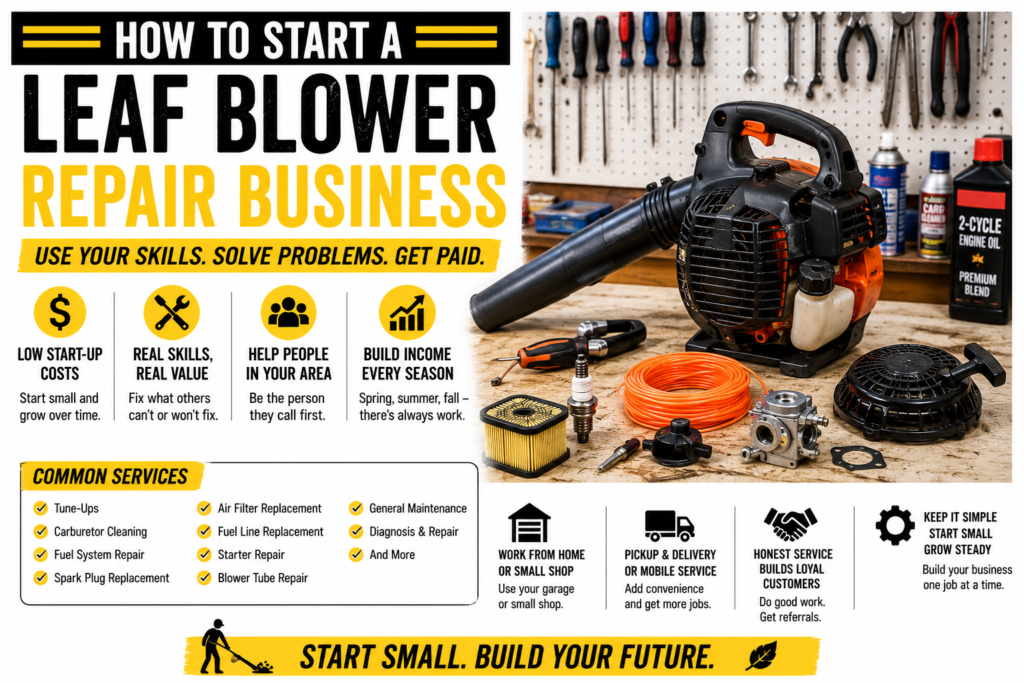
What Is a Leaf Blower Repair Business?
A leaf blower repair business repairs and maintains leaf blowers and related small-engine equipment.
Common services may include:
- Repairing leaf blowers that will not start
- Cleaning and servicing carburetors
- Replacing spark plugs
- Replacing fuel lines
- Replacing fuel filters
- Replacing air filters
- Repairing starter systems
- Repairing fuel system problems
- Replacing worn parts
- Performing tune-ups
- Diagnosing engine problems
- General maintenance
You do not have to offer every service when you begin. Start with the repairs you know how to perform and expand as your skills and equipment grow.
Why Start a Leaf Blower Repair Business?
Leaf blowers are used by many homeowners and landscaping businesses. They also need maintenance and eventually develop problems.
That creates an opportunity for someone who knows how to repair them.
You have a skill. Someone has a problem. Your business connects the two.
You Can Start With Skills You Already Have
If you already repair lawn mowers, chainsaws, string trimmers, generators, or other small engines, you may already have many of the skills needed to work on leaf blowers.
You may have learned those skills through a job, from a family member, through years of working on equipment, or simply by teaching yourself.
You do not necessarily need a college degree to solve a mechanical problem.
You Can Start With Limited Money
A leaf blower repair business can be started much smaller than many traditional businesses.
You may not need employees, a large building, or a large inventory of parts.
If you already own basic tools, your initial investment may be relatively small.
You Can Start Part-Time
You do not have to quit your current job or make the business full-time immediately.
You can start by taking a few repair jobs each week and see how much demand exists in your area.
If the customer base grows, you can decide whether to increase your hours.
How Much Money Do You Need to Start?
Your startup cost depends on what you already own.
Basic equipment may include:
- Socket set
- Wrench set
- Screwdrivers
- Pliers
- Nut drivers
- Torque wrench
- Multimeter
- Spark tester
- Compression tester
- Work light
- Cleaning supplies
- Oil drain container
- Replacement spark plugs
- Fuel line
- Fuel filters
- Air filters
You do not need to buy all of these tools on the first day.
If money is tight, start with the tools you already have and buy additional equipment when a real business need appears.
Do Not Spend Your Savings on a Shop
One of the biggest mistakes a new business owner can make is spending too much money before finding customers.
You may see large repair shops with expensive equipment and think you need the same setup.
You do not.
Start with the smallest version of the business that can work.
If customers begin bringing you more complicated repairs, you can use some of your profits to buy better tools and equipment.
Can You Run the Business From Home?
Depending on where you live, you may be able to operate a small repair business from a garage, shed, or home workshop.
However, local zoning, business licensing, environmental, storage, and other rules may apply.
Check your local requirements before starting a home-based repair business.
You also need a safe place to store customer equipment, parts, fuel, oil, and other materials.
Common Leaf Blower Problems
Understanding common problems can help you build your service list.
Leaf Blower Will Not Start
A blower that will not start is one of the most common repair problems.
The cause could involve old fuel, a dirty carburetor, a bad spark plug, a clogged fuel system, an ignition problem, or another engine issue.
Your job is to diagnose the problem instead of replacing parts randomly.
Leaf Blower Starts and Dies
A blower that starts but quickly dies may have a fuel, carburetor, air, ignition, or adjustment problem.
The exact cause depends on the equipment.
Good diagnosis can save the customer money and help build your reputation.
Leaf Blower Runs Poorly
A blower that runs rough, loses power, or does not operate normally may need maintenance or repair.
You can inspect appropriate components such as the air filter, fuel system, spark plug, carburetor, exhaust system, and other parts.
Starter Problems
Pull-start systems can become worn or damaged.
If you understand how recoil starters work, starter repair can become another service you offer.
Fuel System Problems
Old fuel and long periods of storage can cause problems in small engines.
Fuel lines, filters, carburetors, and other components may need cleaning, replacement, or repair.
Leaf Blower Tune-Up Service
A tune-up can be an easy service for customers to understand.
Depending on the equipment and manufacturer’s recommendations, a tune-up may include:
- Checking or replacing the spark plug
- Inspecting the air filter
- Checking the fuel system
- Inspecting fuel lines
- Cleaning appropriate components
- Checking the starter system
- Inspecting other visible components
- Performing recommended maintenance
A tune-up can also help identify problems before the customer needs the machine.
Chain of Customers: One Repair Can Lead to Another
Many people who own leaf blowers also own other outdoor equipment.
A customer may bring you a leaf blower and later ask you to repair their lawn mower, string trimmer, chainsaw, or snow blower.
This is one reason it can make sense to build a broader small-engine repair business over time.
You do not have to advertise every service immediately. Add services as you gain experience.
How to Find Your First Customers
You do not need a large advertising budget to get started.
Begin with people and businesses near you.
Tell People You Know
Tell your neighbors, friends, family members, former coworkers, and other people in your community that you repair leaf blowers.
Be specific.
You could say:
“I repair leaf blowers that won’t start, run poorly, or need maintenance.”
That makes your service easy to understand.
Use Local Community Groups
Local online groups can be useful for finding nearby customers.
Keep your advertisement simple.
Tell people:
- What equipment you repair
- What problems you handle
- Where you provide service
- Whether you offer pickup and delivery
- How to contact you
Use Flyers and Business Cards
A simple flyer can work well for a local repair business.
For example:
LEAF BLOWER WON’T START?
REPAIR • TUNE-UPS • MAINTENANCE
Then list your service area and contact information.
Only advertise in locations where local rules allow it.
Work With Landscaping Companies
Landscapers use leaf blowers regularly, so they can be a good source of repeat customers.
A homeowner may use a blower a few times each year. A landscaping company may use several blowers every day.
Introduce yourself to local landscaping companies and explain what you repair.
You do not need every landscaper in town to become your customer. A few repeat customers can make a big difference to a small business.
How Much Should You Charge?
Your prices should cover your time, parts, supplies, transportation, tools, and other business expenses.
You are not simply charging for a replacement part.
The customer is paying for your:
- Knowledge
- Experience
- Diagnosis
- Labor
- Tools
- Time
Flat-Rate Pricing
You can charge a set price for simple services that are easy to estimate.
This may work well for certain tune-ups, maintenance services, and other common repairs.
Hourly Labor
More complicated repairs may be easier to charge based on labor time.
This can be useful when you do not know how long the repair will take.
Diagnostic Fee
You can charge a diagnostic fee for inspecting equipment and determining what is wrong.
Some repair businesses apply the diagnostic fee toward the repair if the customer approves the work.
Explain your pricing before beginning major work.
Do Not Forget Your Time
New business owners sometimes charge only enough to cover the parts.
That is a mistake.
Your time has value.
If you spend an hour diagnosing a machine and another hour repairing it, the customer is paying for those two hours of work, not just the spark plug or fuel line.
Pickup and Delivery
Some customers may not have a convenient way to transport their equipment.
Offering pickup and delivery can make your business more attractive.
You can charge a transportation fee or include the cost in your repair price.
Make sure the customer understands the charge before you pick up the equipment.
Mobile Leaf Blower Repair
Some repairs can be performed at the customer’s home or business.
Mobile service can save customers time and eliminate the need for them to transport their equipment.
However, travel takes time and costs money.
Your pricing should account for fuel, vehicle costs, and travel time.
Build Trust With Customers
A small repair business depends heavily on trust.
Customers are giving you equipment that belongs to them. They want to know that you will take care of it.
Simple things can help build trust:
- Return phone calls.
- Show up when you say you will.
- Explain the problem in simple language.
- Give a price before major repairs.
- Keep customer equipment organized.
- Do not replace parts that do not need replacing.
- Be honest when a repair is not worthwhile.
- Finish the work when promised.
Good service can turn a first-time customer into a repeat customer.
What If You Have Little Money?
You can start with the smallest version of the business that makes sense for you.
You might begin with:
- Basic diagnosis
- Leaf blower tune-ups
- Spark plug replacement
- Fuel system service
- Air filter replacement
- Starter repairs
Then add more services as customers request them.
You do not need to prove that you can repair every type of equipment before you start.
You need to find out whether people are willing to pay for the skills you already have.
Can You Start Part-Time?
Yes.
Starting part-time can be a good way to reduce financial pressure.
You can take a few jobs each week and learn how the business works.
As you gain customers, you can decide whether you want to increase your workload.
You are not required to turn a small side business into a full-time company.
What If You Are Retired?
A leaf blower repair business can be operated part-time.
You can decide how many customers you want to handle and how many hours you want to work.
If you enjoy fixing equipment and want to earn extra money, a small repair business can give you a way to use your skills without committing to a traditional job.
What If You Do Not Like Resumes and Interviews?
Some people simply do not like the traditional job search.
They would rather work with their hands than fill out applications, send resumes, and sit through interviews.
A small repair business gives you another option.
You can use your skills to solve a real problem for a real customer.
You are not asking an employer to take a chance on you. You are offering a service that solves a problem.
What If You Have a Criminal Record?
A criminal record can make traditional employment more difficult for some people.
Self-employment can provide another possible path for someone who has useful skills.
A customer with a broken leaf blower may care about whether you can fix it, communicate clearly, charge a fair price, and provide good service.
You still need to follow all applicable laws, licensing requirements, insurance requirements, and other rules in your area.
Keep Good Records
You do not need complicated accounting software when you are starting.
You do need to know where your money is going.
For each repair, keep track of:
- Customer name
- Contact information
- Equipment make and model
- Problem reported
- Diagnosis
- Parts used
- Labor time
- Total price
- Payment received
Also keep records of your business expenses and follow applicable tax requirements.
Common Mistakes to Avoid
Buying Too Much Equipment
Do not spend your entire savings on tools and equipment before you have customers.
Taking Every Job
If you do not understand a repair or cannot perform it safely, do not accept the job just because you want the money.
Replacing Parts Without Diagnosing the Problem
Randomly replacing parts can quickly become expensive.
Take the time to understand the problem.
Underpricing Your Work
Being affordable is good. Losing money on every job is not.
Your prices need to cover your costs and provide a reasonable return for your time.
Ignoring Customer Service
Good mechanical work is important, but customers also remember whether you were reliable, honest, and easy to deal with.
How to Grow a Leaf Blower Repair Business
You can expand slowly as your customer base grows.
A possible growth path could look like this:
- Start with basic leaf blower repairs.
- Add tune-up services.
- Add pickup and delivery.
- Offer mobile repair.
- Add string trimmer repair.
- Add lawn mower repair.
- Add chainsaw repair.
- Add snow blower repair.
- Add generator repair.
- Build repeat customers.
You do not have to follow this exact path.
Pay attention to what people in your area actually need and build your services around that demand.
Is a Leaf Blower Repair Business Right for You?
If you enjoy working with machines, fixing problems, and working with your hands, a leaf blower repair business may be worth considering.
You do not need a large investment to test the idea.
Start with the tools you already have. Offer a few services you know how to perform. Find customers who need those services. Do good work and get paid.
Then use some of the money you earn to improve the business.
You do not need a perfect resume, a college degree, or a large building to start solving problems for customers.
You need a useful skill, a customer with a problem, and the willingness to do good work.
Next Article
How to Start a Generator Repair Business
Previous Article
How to Start a String Trimmer Repair Business
Related Articles
If you are interested in building a business around small-engine repair skills, these related guides may also help:
- Start a Small Engine Repair Business
- Lawn Mower Repair Business
- Snow Blower Repair Business
- Chainsaw Repair Business
- String Trimmer Repair Business
- Generator Repair Business
- Pressure Washer Repair Business
- Riding Lawn Mower Repair Business
- Small Engine Tune-Up Service
- Mobile Small Engine Repair Business