If you know how to repair engines, vehicles, or mechanical equipment, an ATV repair business can be a way to turn your skills into income. ATVs are used for recreation, farming, property maintenance, hunting, trail riding, and other activities. When an ATV will not start or has a mechanical problem, the owner needs someone who can find the problem and fix it.
You do not need to open a large repair shop to get started. If you already have tools and mechanical experience, you can begin with the repairs you understand, work with a small number of customers, and grow the business as you earn money.
This guide explains how to start an ATV repair business, what services you can offer, what tools you may need, how to find customers, how to set prices, and how to build the business slowly without spending more money than you can afford.
What Is an ATV Repair Business?
An ATV repair business repairs and maintains all-terrain vehicles and related recreational equipment.
Depending on your skills, you may work on utility ATVs, recreational ATVs, older machines, or other off-road equipment.
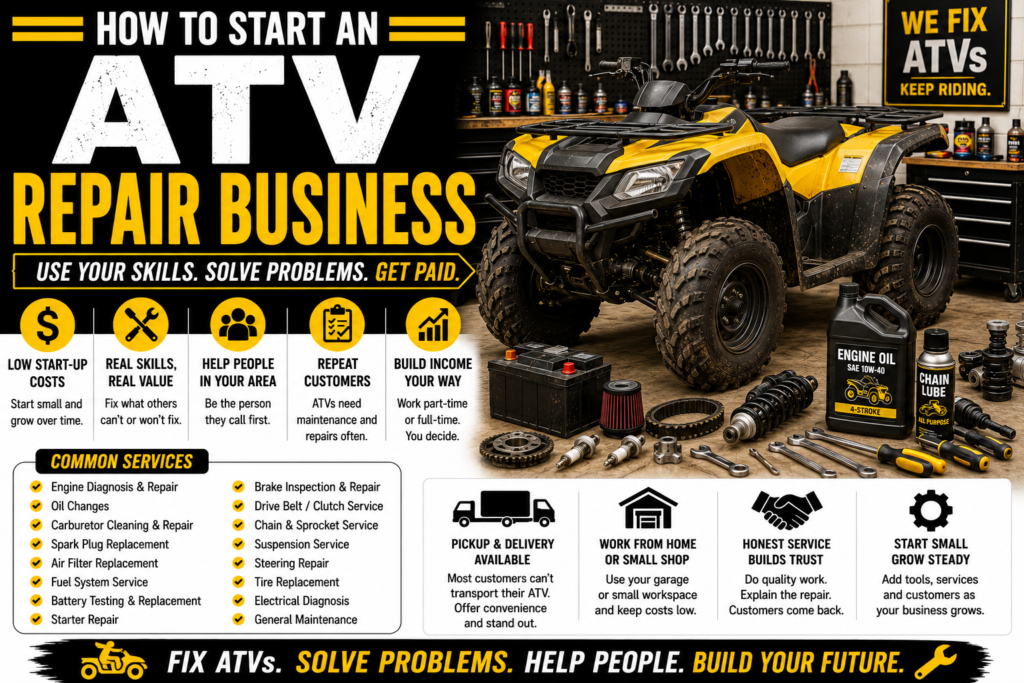
Common services may include:
- Engine diagnosis
- Engine repair
- Oil changes
- Spark plug replacement
- Air filter replacement
- Fuel system service
- Carburetor cleaning and repair
- Battery testing and replacement
- Starter repair
- Brake inspection and repair
- Chain and drive-system service
- Belt and clutch service
- Suspension service
- Steering repair
- Tire replacement
- General maintenance
You do not need to offer every service when you start.
Start with the work you know how to perform safely. Add services as your experience, tools, and customer base grow.
Why Start an ATV Repair Business?
ATVs can be expensive machines. When an owner has a problem, repairing the existing ATV may make more sense than replacing it.
ATV owners may also need regular maintenance because they ride in dirt, mud, dust, water, and other conditions that can be hard on equipment.
That creates an opportunity for a skilled repair person.
You have a skill. The customer has a broken machine. Your business provides the solution.
You Can Use Skills You Already Have
If you have repaired motorcycles, go-karts, lawn mowers, generators, riding lawn mowers, golf carts, or other small engines, you may already have useful skills for ATV repair.
You may have learned these skills through a job, trade work, military experience, hobbies, family members, or years of repairing your own equipment.
A customer is usually interested in whether you can solve the problem, not whether you learned the skill in a classroom.
You Can Start Small
You do not need a large commercial building to test the business.
Depending on local rules, you may be able to start from a garage or small workshop.
You can also offer pickup and delivery or mobile service when appropriate.
You Can Work Part-Time
You can start with a few repair jobs each week.
This gives you an opportunity to learn about your local market before depending on the business for all of your income.
If demand grows, you can decide whether you want to work more hours.
How Much Money Do You Need to Start?
Your startup cost depends on the tools you already own and the types of ATVs you plan to repair.
Basic tools may include:
- Socket set
- Wrench set
- Screwdrivers
- Pliers
- Nut drivers
- Torque wrench
- Multimeter
- Spark tester
- Compression tester
- Battery tester
- Work light
- Jack or appropriate lifting equipment
- Oil drain pan
- Cleaning supplies
As you take on more complicated ATV repairs, you may need additional specialty tools.
Do not buy every tool before you have customers.
Buy equipment when the business gives you a reason to own it.
Start With the ATVs You Understand
ATVs can have different engines, transmissions, drive systems, electrical systems, and suspension designs.
If you are new to ATV repair, start with equipment you understand.
Learn the common problems and service requirements for the types of ATVs found in your area.
You can expand your knowledge and services over time.
Can You Run the Business From Home?
Possibly. Local laws and zoning rules vary.
Before operating a home-based repair business, check local requirements involving zoning, customer traffic, noise, fuel storage, waste oil, and other issues.
You also need enough space to safely store customer ATVs.
ATVs are much larger than handheld equipment, so storage and security should be considered before you begin.
Safety Is Extremely Important
ATVs contain engines, fuel systems, batteries, brakes, steering systems, suspension components, chains, belts, wheels, and other parts that can create serious safety risks if they are not repaired correctly.
Safety-related repairs require particular care.
Follow the manufacturer’s service information and use the correct tools and procedures.
If you do not understand a repair or cannot perform it safely, do not accept the job.
Common ATV Problems
ATV Will Not Start
This is one of the most common ATV repair complaints.
The cause may involve the battery, starter, fuel system, spark plug, carburetor, ignition system, or engine.
Start with diagnosis instead of replacing parts randomly.
ATV Starts but Runs Poorly
An ATV that starts but runs poorly may have a fuel, air, ignition, carburetor, sensor, or other mechanical problem.
The exact cause depends on the machine.
Proper diagnosis can save both you and the customer money.
ATV Has No Power
A loss of performance can have several causes.
The engine may need maintenance, the fuel system may have a problem, or another mechanical component may be affecting performance.
Test the appropriate systems before replacing expensive parts.
Battery Keeps Going Dead
A battery that repeatedly loses its charge may be old or damaged, but the problem may also involve the charging system, wiring, or another electrical component.
Replacing the battery without finding the underlying problem may not solve the customer’s problem.
ATV Will Not Move
An ATV that starts but does not move may have a problem involving the transmission, clutch, drive belt, chain, axle, or another component.
The exact system depends on the ATV.
Brake Problems
Brakes are a critical safety system.
Customers may need brake inspection, adjustment, or replacement of worn components.
Only perform brake repairs if you understand the system and can complete the work safely.
Steering or Suspension Problems
Loose steering, damaged suspension components, worn bearings, or other problems can affect the safe operation of an ATV.
These systems should be inspected carefully.
ATV Maintenance Services
Preventive maintenance can become an important part of your business.
Depending on the ATV and manufacturer’s recommendations, maintenance may include:
- Oil service
- Spark plug inspection or replacement
- Air filter inspection or replacement
- Fuel system inspection
- Battery inspection
- Brake inspection
- Chain or drive-system inspection
- Belt inspection
- Tire inspection
- Steering inspection
- Suspension inspection
- General mechanical inspection
Always follow the manufacturer’s maintenance requirements for the specific ATV.
Pre-Season ATV Service
Many ATV owners may leave their machines sitting for long periods.
When riding season arrives, they may discover that the ATV will not start or needs maintenance.
You can offer a pre-season inspection and service to help customers get their machines ready.
This can also create repeat business because customers may return for maintenance each year.
How to Find Your First Customers
You do not need expensive advertising to begin.
Start with people who own recreational equipment in your area.
Tell People You Know
Tell your friends, family members, neighbors, former coworkers, and other people you know that you repair ATVs.
Be specific about the problems you solve.
You could say:
“I repair ATVs that won’t start, run poorly, or need mechanical maintenance.”
This is easier for people to understand than simply saying you are a mechanic.
Use Local Online Groups
Local community and recreational groups can help you reach ATV owners.
Keep your advertisement simple.
Explain:
- What ATVs you work on
- What repairs you offer
- What area you serve
- Whether you offer pickup and delivery
- How customers can contact you
Connect With ATV Hobbyists
ATV owners often know other people who ride.
A satisfied customer can become an important source of referrals.
Good work and honest service can be more valuable than expensive advertising.
Work With Farms and Property Owners
ATVs are often used for more than recreation.
Farmers, property owners, hunting properties, and other rural businesses may use ATVs to move around large areas.
These customers may need reliable equipment and regular maintenance.
Building relationships with local property owners and businesses can create repeat work.
How Much Should You Charge?
Your prices should cover your labor, parts, supplies, transportation, tools, and other business expenses.
The customer is paying for more than the replacement part.
They are paying for your:
- Knowledge
- Experience
- Diagnosis
- Labor
- Tools
- Time
Diagnostic Fee
A diagnostic fee can make sense because ATV problems are not always obvious.
You may need to inspect and test several systems before determining what is wrong.
Some businesses apply the diagnostic fee toward the repair if the customer approves the work.
Hourly Labor
Complicated repairs may be easier to charge based on labor time.
This can be useful when you cannot accurately estimate the repair before diagnosis.
Flat-Rate Services
Simple maintenance services may work well with a set price.
This makes it easier for customers to understand the cost before approving the work.
Explain the price before beginning major repairs.
Do Not Forget Your Time
New repair businesses sometimes charge only enough to cover the parts.
That can make it difficult to build a profitable business.
If you spend several hours diagnosing and repairing an ATV, your labor has value.
Your pricing should reflect your time, knowledge, tools, and business expenses.
Pickup and Delivery
ATVs can be difficult for customers to transport.
If you have an appropriate truck, trailer, ramps, and equipment, pickup and delivery can become another service you offer.
Transportation also costs money, so your pricing should account for fuel, driving time, loading, unloading, and vehicle expenses.
Make sure the ATV is secured properly during transportation.
Mobile ATV Repair
Some repairs can be performed at the customer’s property.
Mobile repair can save customers the trouble of transporting their ATV.
It can also make your business more convenient than a traditional repair shop.
Make sure you have the tools needed for the job and a safe location to perform the repair.
Build Trust With Customers
ATV owners are trusting you with an expensive piece of equipment.
Good customer service can help you stand out.
- Return phone calls.
- Show up when promised.
- Explain the problem clearly.
- Give an estimate before major repairs.
- Take care of customer property.
- Keep track of parts.
- Be honest about what needs to be repaired.
- Tell customers when a repair may not be worth the cost.
- Finish the work when promised.
A customer who trusts you may return for maintenance and recommend you to other ATV owners.
What If You Have Little Money?
You can begin with a limited service list.
For example, you could start with:
- Basic ATV diagnosis
- Oil changes
- Spark plug replacement
- Air filter replacement
- Battery testing
- Fuel system service
- Basic engine repairs
- General maintenance
As customers pay you, you can reinvest some of the money into better tools and equipment.
You do not need to build a large shop before you know whether the business will work.
Can You Start Part-Time?
Yes.
You can start with a few jobs each week.
This allows you to test your local market and build experience without immediately depending on the business for all your income.
As demand increases, you can decide whether to work more hours.
What If You Are Retired?
An ATV repair business can be operated part-time.
You can decide how many customers you want to handle and how many hours you want to work.
If you enjoy mechanical work and want extra income, this can be a way to use skills you already have.
What If You Do Not Like Resumes and Job Interviews?
Some people would rather work with their hands than spend their time applying for jobs, writing resumes, and sitting through interviews.
If you have mechanical skills, self-employment can provide another possible path.
You have a skill that can solve a real problem.
A customer has an ATV that needs attention.
Your business connects your skill with that customer’s problem.
What If You Have a Criminal Record?
A criminal record can make traditional employment more difficult for some people.
Self-employment can provide another possible path for someone with useful skills.
A customer may care more about whether you can repair the ATV properly, communicate honestly, and provide dependable service.
You still need to follow all applicable laws, licensing requirements, insurance requirements, and other rules in your area.
Keep Good Records
Good records help you keep track of repairs and understand whether your business is making money.
For each repair, record:
- Customer name
- Contact information
- ATV make and model
- Problem reported
- Diagnosis
- Parts used
- Labor time
- Pickup or delivery charges
- Total price
- Payment received
Also keep records of your business expenses and follow applicable tax requirements.
Common Mistakes to Avoid
Buying Too Many Tools
Do not spend all your savings on equipment before you have customers.
Taking Jobs You Cannot Handle
Know your limits. Do not accept repairs you cannot perform safely.
Ignoring Safety Systems
Brakes, steering, suspension, tires, and other safety-related systems require careful attention.
Replacing Parts Without Diagnosing the Problem
Random parts replacement can become expensive quickly.
Underpricing Your Work
Your time and skills have value. Make sure your prices cover your costs and labor.
Forgetting Transportation Costs
If you offer pickup and delivery, make sure your prices cover the real cost of transporting ATVs.
How to Grow an ATV Repair Business
You can expand the business slowly as your customer base grows.
A possible growth path could look like this:
- Start with basic ATV repairs.
- Add maintenance services.
- Add battery and electrical diagnosis.
- Add brake and suspension service.
- Offer pickup and delivery.
- Offer mobile repair.
- Build relationships with farms and property owners.
- Add go-kart repair.
- Add golf cart repair.
- Expand into additional recreational equipment.
You do not have to follow this exact path.
Build around the skills you have and the equipment customers in your area actually need repaired.
Is an ATV Repair Business Right for You?
If you enjoy working with engines, machines, and recreational equipment, an ATV repair business may be worth considering.
You can start small without a large building or a huge investment.
Use the tools and skills you already have. Start with repairs you understand. Find customers who need those repairs. Do good work and get paid.
Then use some of your earnings to improve the business.
You do not need a perfect resume, a college degree, or a traditional job to earn money from a useful skill.
Find a problem. Solve it. Help the customer. Get paid. Build from there.
Next Article How to Start a Small Engine Tune-Up Service
Previous Article How to Start a Golf Cart Repair Business
Related Articles
If you are interested in turning mechanical skills into a small business, these related guides may also help:
- Start a Small Engine Repair Business
- Lawn Mower Repair Business
- Snow Blower Repair Business
- Chainsaw Repair Business
- Generator Repair Business
- Pressure Washer Repair Business
- Riding Lawn Mower Repair Business
- Go-Kart Repair Business
- Golf Cart Repair Business
- Small Engine Tune-Up Service
- Mobile Small Engine Repair Business