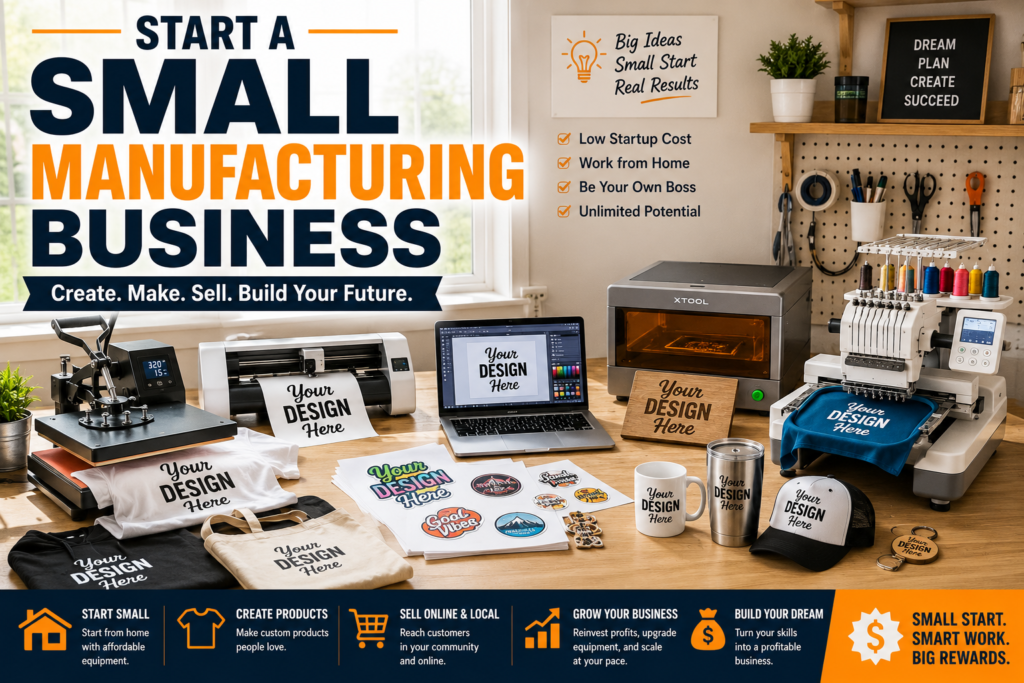
Many people dream of owning a manufacturing business but assume it requires a large factory, expensive machinery, and hundreds of thousands of dollars. The truth is, many successful manufacturing businesses begin in a garage, spare bedroom, workshop, or small commercial space with a modest investment.
Today, entrepreneurs manufacture everything from custom T-shirts and vinyl decals to laser-engraved gifts, embroidered apparel, personalized signs, and promotional products. Affordable equipment, online marketplaces, and e-commerce have made it easier than ever to start manufacturing products on a small scale while serving local customers and buyers across the country.
At StartBusinessHub.COM, we believe every successful business begins by solving a real problem. Instead of asking, “What business should I start?” ask yourself, “What problem can I solve?” The businesses that succeed over the long term are the ones that provide valuable solutions, deliver quality products, and consistently meet customer needs.
What Is a Small Manufacturing Business?
A small manufacturing business creates physical products on a limited scale using specialized equipment, skilled labor, or custom production methods. Unlike large factories that mass-produce thousands of identical products, small manufacturers typically focus on customized, made-to-order, or niche products that larger companies may not offer.
Many small manufacturers operate from home during their early stages before expanding into commercial workshops or retail locations as demand increases.
Common examples include:
- Custom T-shirt printing
- Vinyl decals
- Custom stickers
- Laser engraving
- Embroidery
- Personalized gifts
- Awards and trophies
- Promotional products
- Signs and banners
- Custom woodworking
- Sublimation printing
- 3D printing
The flexibility of small-scale manufacturing allows entrepreneurs to start with one specialty and gradually expand into additional products and services.
What Problem Does a Small Manufacturing Business Solve?
Every successful manufacturing business exists because customers need products that are personalized, produced quickly, or unavailable through mass-market retailers.
Small manufacturers solve problems for:
- Businesses needing branded merchandise
- Schools ordering team apparel
- Sports teams purchasing uniforms
- Churches promoting community events
- Contractors needing company uniforms
- Organizations ordering promotional products
- Families creating reunion shirts
- Companies purchasing employee recognition awards
- Individuals looking for personalized gifts
Understanding the customer’s problem is the foundation of every successful manufacturing business. The better you solve that problem, the more valuable your business becomes.
Why Customers Choose Small Manufacturers
Customers often prefer small manufacturers because they offer advantages that larger companies cannot always provide.
These advantages include:
- Personalized service
- Custom-made products
- Faster turnaround times
- Smaller minimum order quantities
- Local support
- Greater design flexibility
- Better communication
- Higher attention to detail
Many customers are willing to pay more for products that are customized, professionally made, and delivered on time.
Benefits of Starting a Small Manufacturing Business
Small manufacturing businesses offer several advantages for new entrepreneurs.
Some of the biggest benefits include:
- Relatively low startup costs
- Ability to start from home
- High demand for customized products
- Opportunities for repeat customers
- Flexible work schedule
- Scalable business model
- Strong profit margins on personalized products
- Multiple opportunities to expand into related services
As your customer base grows, you can increase revenue by adding new products, investing in additional equipment, or hiring employees.
Popular Small Manufacturing Business Ideas
There are many manufacturing businesses that can be started with a relatively small investment.
Some of the most popular options include:
- T-Shirt Printing
- Vinyl Decals
- Custom Stickers
- Laser Engraving
- Embroidery
- Sublimation Printing
- Promotional Products
- Personalized Gifts
- Custom Signs
- Awards and Trophies
- CNC Woodworking
- 3D Printing
Many successful entrepreneurs begin with one specialty before expanding into several complementary services.
How Much Does It Cost to Start?
Startup costs depend on the products you plan to manufacture, the equipment you purchase, and whether you operate from home or lease commercial space.
Typical startup investments include:
| Business | Estimated Startup Cost |
|---|---|
| T-Shirt Printing | $2,000–$8,000 |
| Vinyl Decals | $1,000–$4,000 |
| Custom Stickers | $1,500–$6,000 |
| Laser Engraving | $3,000–$12,000 |
| Embroidery | $5,000–$15,000 |
Starting with one product line allows you to learn the business while keeping costs under control.
Equipment You’ll Need
The equipment required depends on the products you plan to manufacture.
Common equipment includes:
- Computer
- Design software
- Heat press
- Vinyl cutter
- Laser engraver
- Embroidery machine
- Printer
- Packaging supplies
- Shipping scale
- Work tables
- Storage shelves
- Safety equipment
Purchase reliable equipment that matches your current production needs. It’s usually better to upgrade as your business grows rather than buying expensive commercial equipment before you have consistent sales.
Skills You’ll Need
You don’t need a manufacturing degree to succeed.
Helpful skills include:
- Graphic design
- Customer service
- Basic computer skills
- Time management
- Product quality control
- Organization
- Marketing
- Social media
- Sales
- Attention to detail
Most of these skills can be learned through practice, online training, and experience.
How to Start a Small Manufacturing Business
1. Choose the Right Product
Select a product that solves a real customer problem and fits your interests, budget, and available workspace.
2. Research Your Market
Identify your target customers, study local competitors, and determine what makes your products different.
3. Write a Business Plan
Outline your startup costs, pricing strategy, target market, marketing plan, and financial goals.
4. Register Your Business
Choose a business structure, register your business name, obtain any required licenses, and apply for the appropriate tax identification numbers.
5. Purchase Equipment
Buy dependable equipment that allows you to produce quality products without exceeding your startup budget.
6. Create Sample Products
Build a portfolio that demonstrates your craftsmanship and gives potential customers confidence in your work.
7. Set Your Prices
Calculate material costs, labor, overhead, packaging, shipping, and profit before setting your prices.
8. Build Your Online Presence
Create a professional website, establish your social media profiles, and claim your business listings to help customers find you.
9. Start Marketing
Network with local businesses, attend community events, ask for referrals, and promote your products online.
10. Improve and Expand
As your business grows, add new products, improve production efficiency, invest in better equipment, and build long-term customer relationships.
Common Mistakes to Avoid
Many new business owners make the same costly mistakes.
Avoid these common problems:
- Buying expensive equipment before finding customers
- Underpricing your products
- Ignoring production time
- Accepting every custom order
- Poor quality control
- Failing to track expenses
- Weak marketing
- Not asking for customer reviews
- Trying to offer too many products too soon
Focusing on one product and doing it exceptionally well is often a better strategy than trying to manufacture everything.
How Much Money Can You Make?
Income varies depending on the products you manufacture, your pricing, production capacity, and customer base.
Many entrepreneurs begin part-time while building experience and a loyal customer base. As repeat customers increase and operations become more efficient, many businesses transition into full-time income.
Businesses that focus on quality, customer service, and repeat commercial clients often have the greatest long-term earning potential.
How to Grow Your Manufacturing Business
Once your business is established, there are many ways to increase revenue.
Consider expanding by:
- Adding complementary manufacturing services
- Selling online nationwide
- Offering wholesale pricing
- Creating business-to-business accounts
- Hiring employees
- Purchasing commercial equipment
- Opening a retail showroom
- Launching your own online store
- Offering design services
- Developing recurring commercial contracts
Growth should be intentional and based on customer demand rather than simply purchasing more equipment.
Choose Your Manufacturing Business
Every manufacturing business has different startup costs, equipment requirements, and target customers. Explore the guides below to find the business that best matches your goals.
How to Start a T-Shirt Printing Business
Create custom apparel for businesses, schools, sports teams, churches, nonprofits, and special events. Learn about startup costs, printing methods, equipment, pricing, and how to find your first customers.
Learn More → How to Start a T-Shirt Printing Business
How to Start a Vinyl Decal Business
Design and produce custom decals for vehicles, storefronts, walls, equipment, and promotional products. Discover the equipment you’ll need, pricing strategies, and ways to attract repeat business customers.
Learn More → How to Start a Vinyl Decal Business
How to Start a Custom Sticker Business
Manufacture custom stickers for businesses, online sellers, product packaging, schools, artists, and events. Learn how to choose equipment, price your products, and build a profitable sticker business.
Learn More → How to Start a Custom Sticker Business
How to Start a Laser Engraving Business
Personalize wood, metal, leather, acrylic, glass, and other materials with custom engraving. Explore startup costs, equipment, safety considerations, and profitable products to sell.
Learn More → How to Start a Laser Engraving Business
How to Start an Embroidery Business
Produce embroidered shirts, hats, jackets, uniforms, and promotional apparel for businesses and organizations. Learn about embroidery machines, pricing, and growing a business with repeat customers.
Learn More → How to Start an Embroidery Business
Is a Small Manufacturing Business Right for You?
A small manufacturing business may be an excellent fit if you:
- Enjoy creating physical products
- Like solving customer problems
- Have good attention to detail
- Are willing to learn new skills
- Want to build a business that can grow over time
- Prefer making customized products rather than mass-produced items
If that sounds like you, a small manufacturing business could provide a rewarding path toward business ownership.
Frequently Asked Questions
Is a small manufacturing business profitable?
Yes. Many small manufacturers earn strong profit margins by producing customized products with relatively low overhead while building long-term relationships with repeat customers.
Can I start a manufacturing business from home?
Yes. Many businesses, including T-shirt printing, vinyl decals, custom stickers, laser engraving, and embroidery, can begin from a home workshop if local zoning regulations allow home-based businesses.
What is the easiest manufacturing business to start?
T-shirt printing, vinyl decals, and custom stickers are often considered beginner-friendly because they have moderate startup costs, manageable equipment requirements, and steady demand.
Do I need manufacturing experience?
No. Many successful business owners begin with little or no experience and learn through online training, practice, and hands-on experience.
How much money do I need to start?
Depending on the type of manufacturing business, startup costs typically range from $1,000 to $15,000.
What products sell well year-round?
Custom apparel, decals, stickers, business signage, promotional products, engraved gifts, and embroidered uniforms all experience consistent demand throughout the year.
Final Thoughts
Starting a small manufacturing business is about much more than buying equipment and making products. It’s about identifying a real need, creating high-quality solutions, and building lasting relationships with customers who value your work.
You don’t need a large factory or a massive budget to get started. Many successful businesses begin with one product, one machine, and one satisfied customer at a time. As your skills improve and your reputation grows, you can expand your product line, increase production, and build a business that provides long-term income and opportunities.
At StartBusinessHub.COM, our mission is simple:
Build a Better Future by Solving Real Problems.
No matter which manufacturing business you choose, keep your focus on helping customers solve their problems, and you’ll be building a business on a foundation designed for long-term success.